
Africa’s Gambling Crisis in 2026: How Unemployed Youth Are Chasing Betting Dreams to Escape Poverty — and Falling Deeper Into Debt
Africa’s gambling boom is pulling thousands of unemployed youth into betting platforms promising quick riches. Explore the real reasons behind rising gambling addiction, economic pressures, digital betting apps, and what governments and communities can do in 2026.
AWARENESS
2/24/20264 min read
Africa’s Gambling Boom Is Turning Into a Youth Debt Trap in 2026
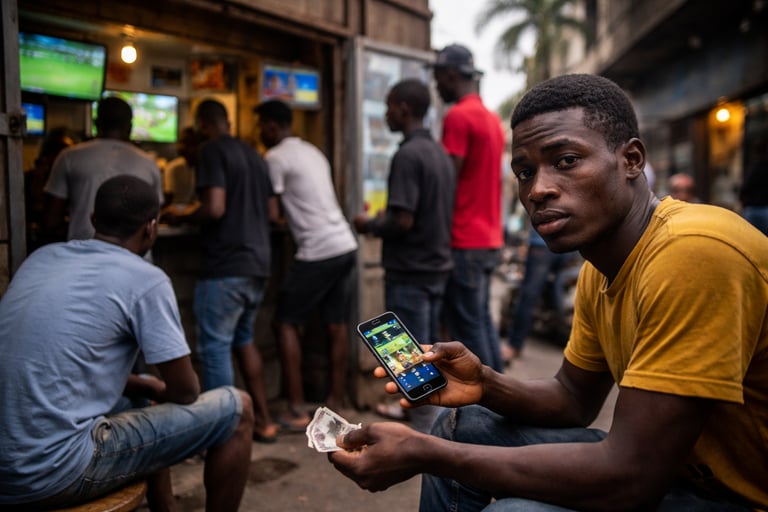
Across multiple African nations, sports betting shops and mobile gambling apps have rapidly expanded over the past decade. What initially appeared to be harmless entertainment has, for a growing segment of unemployed youth, become a perceived pathway out of poverty.
In countries experiencing high youth unemployment, rising living costs, and limited access to formal job markets, gambling is increasingly viewed as an alternative income strategy. Instead of waiting months for employment opportunities, betting platforms promise instant rewards.
But the reality is more complex.
Rather than financial freedom, many young bettors are finding themselves trapped in recurring cycles of loss, debt, and psychological distress. This is not simply a moral issue — it is an economic and behavioral phenomenon shaped by structural conditions.
Why Youth Unemployment Is Fueling Gambling Growth
Africa has the youngest population in the world. Millions of young people enter the labor market each year. However, job creation often fails to keep pace with population growth.
Several structural factors contribute to the issue:
Limited industrial expansion
Heavy reliance on informal employment
Wage instability
Inflationary pressures
Urban migration without corresponding job availability
When legitimate income pathways feel blocked, individuals naturally explore alternative avenues. In this context, sports betting emerges as an accessible option requiring minimal capital and no formal qualifications.
To a financially strained young person, betting may appear less like gambling and more like calculated risk-taking.
The Rise of Mobile Betting Platforms
The rapid expansion of affordable smartphones and mobile payment systems has transformed gambling accessibility. Betting no longer requires visiting casinos. With a few taps on a mobile screen, wagers can be placed instantly.
Key drivers of expansion include:
Low minimum deposits
Seamless mobile money integration
Instant account creation
Aggressive promotional bonuses
Heavy advertising during football broadcasts
Sports culture, especially European football leagues, plays a central role. Daily matches provide continuous betting opportunities. This creates repeated engagement cycles.
Accessibility is now frictionless — and frictionless access increases impulsive behavior.
Why Gambling Feels Like Hope
Gambling addiction rarely begins with reckless behavior. It often begins with optimism.
Several psychological mechanisms are at play:
1. Variable Reward Reinforcement
Occasional wins release dopamine, reinforcing behavior. The unpredictability of rewards makes the activity compelling.
2. Loss-Chasing Behavior
After experiencing a loss, individuals often increase stakes to recover losses quickly, believing that a win is imminent.
3. Optimism Bias
Many bettors overestimate their knowledge of sports outcomes and underestimate statistical probability.
4. Social Proof
Peer groups gathering in betting shops normalize the behavior. When everyone participates, perceived risk decreases.
Under financial pressure, the appeal of a “single big win” becomes emotionally powerful.
Poverty + Digital Access = A High-Risk Environment
Three major forces converge:
High youth unemployment
Expanding digital connectivity
Aggressive marketing by betting platforms
When opportunity gaps meet technological convenience, high-risk financial behavior becomes widespread.
Importantly, gambling does not create unemployment. It thrives in environments where unemployment already exists.
The Social Consequences Emerging in 2026
While many individuals engage in betting casually, a growing subset faces serious consequences.
Common patterns include:
Repeated financial loss
Borrowing from friends and family
Informal debt accumulation
Selling personal assets
Increased anxiety and depression
Families often feel the secondary effects. Household income that could support basic needs is redirected toward betting activity.
In severe cases, individuals become socially withdrawn or trapped in long-term debt cycles.
The Debt Spiral: How It Typically Develops
The progression often follows a recognizable pattern:
Small deposit
Initial win
Increased confidence
Larger wagers
Significant loss
Borrowed money to recover losses
Repeated attempts to “break even”
This loss-recovery loop can persist for months or years.
Behavioral economists note that once an individual enters the loss-chasing stage, rational financial decision-making weakens significantly.
Why Betting Is Viewed as a Business Strategy
Interestingly, many young bettors do not view themselves as gamblers.
They describe themselves as:
Analysts
Football experts
Strategic predictors
Sports traders
In environments where startup capital for entrepreneurship is unavailable, betting appears to offer a zero-barrier alternative.
However, unlike business ventures, betting odds are structured to ensure long-term profitability for the platform. The mathematical advantage — often called the house edge — ensures that operators maintain consistent margins.
This structural imbalance makes sustained profitability for players statistically unlikely.
The Role of Advertising and Influencer Culture
Betting platforms frequently leverage:
Celebrity endorsements
Sports sponsorships
Referral bonuses
High-visibility billboard campaigns
Social media influencer partnerships
Marketing often frames betting as empowerment rather than risk.
Messages such as “Your moment is now” or “Turn your football knowledge into cash” shift perception from entertainment to opportunity.
For financially stressed youth, such narratives resonate strongly.
Regulatory Responses Across the Continent
Governments have begun recognizing the social implications.
Policy measures include:
Higher taxation on betting companies
Restrictions on advertising
Stricter age verification processes
License revocations
Mandatory responsible gambling warnings
However, enforcement challenges remain. Offshore digital platforms complicate regulation. Informal betting networks also operate outside formal oversight.
Complete prohibition may drive activity underground rather than eliminate it.
The Mental Health Dimension
Gambling addiction intersects closely with mental health.
Research globally associates gambling dependency with:
Anxiety disorders
Depression
Insomnia
Emotional volatility
Substance abuse
Access to mental health services in many regions remains limited. Cultural stigma surrounding addiction can discourage individuals from seeking support.
This makes early intervention difficult.
Is Gambling the Root Cause or a Symptom?
It is critical to distinguish cause from consequence.
Gambling expansion reflects deeper structural pressures:
Youth unemployment
Limited upward mobility
Urban economic stress
Rising living costs
Financial insecurity
When economic mobility appears blocked, speculative behavior increases.
This pattern is not unique to Africa. Similar trends occur in economically stressed regions globally, whether through stock speculation, cryptocurrency trading, or sports betting.
Economic Frustration and the Illusion of Control
Betting provides something psychologically powerful: the illusion of control.
Even when outcomes are statistically uncertain, the act of selecting teams and analyzing odds creates a sense of agency.
For individuals facing limited control in their economic lives, this perceived agency becomes psychologically attractive.
The problem emerges when perceived control replaces realistic assessment of probability.
Community and Family Impact
Families often absorb indirect consequences:
Strained relationships
Reduced trust
Household conflict
Financial instability
In communities where youth unemployment is already high, widespread gambling participation can amplify local economic vulnerability.
Money circulating within betting systems often flows toward centralized operators rather than remaining in local economies.
What Can Actually Reduce Gambling Dependency?
Effective solutions must address root causes rather than symptoms alone.
1. Youth Employment and Skills Programs
Expanding vocational training, digital skills education, and small business financing provides legitimate alternatives.
2. Financial Literacy Education
Understanding probability, risk assessment, and expected value can significantly reduce irrational betting behavior.
3. Platform Accountability
Deposit limits, cooling-off periods, and transparent odds reduce harm.
4. Advertising Restrictions
Limiting youth-targeted marketing reduces exposure.
5. Accessible Mental Health Support
Confidential counseling services can prevent escalation.
The 2026 Turning Point
2026 represents a critical moment.
Digital infrastructure will continue expanding. Smartphone access will grow. Sports broadcasting will remain dominant.
If employment opportunities expand alongside digital growth, gambling risks may stabilize.
If economic pressures intensify without structural reform, dependency rates could rise.
Policy alignment between economic development and digital regulation is essential.
A Balanced Perspective
It is essential not to generalize.
The majority of African youth are hardworking, entrepreneurial, and ambitious. Many engage in betting casually without developing addiction.
The issue lies not in cultural weakness but in economic vulnerability combined with technological access.
Understanding this nuance prevents harmful stereotyping and supports constructive dialogue.
Conclusion: Opportunity Must Replace Illusion
Young people do not gamble because they love risk. They gamble because they seek escape from financial stagnation.
When legitimate opportunities are scarce, high-risk alternatives appear rational.
The long-term solution lies not in blanket bans but in economic empowerment, job creation, education, and responsible regulation.
Hope should be built on opportunity — not probability.
© 2026 All rights reserved.
Follow us
Quick Links