
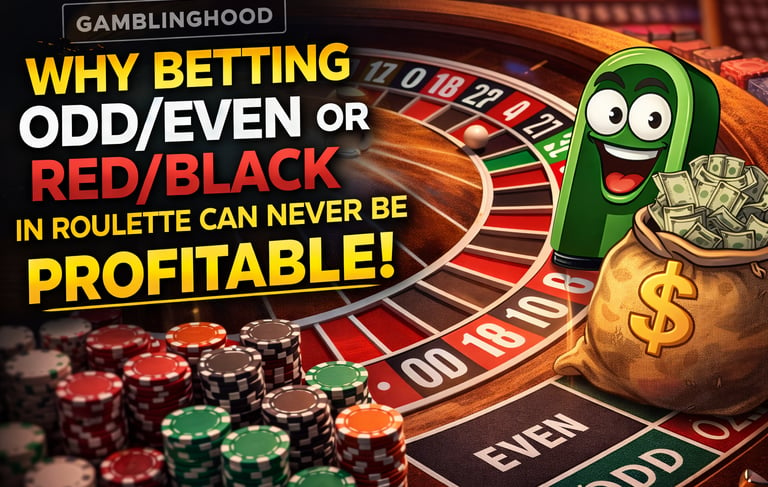
Gamblinghood 2026 Insight — Why Betting on Odd/Even or Red/Black Can Never Be Profitable in Roulette
This comprehensive Gamblinghood analysis explains why betting on odd/even or red/black in roulette can never be profitable in the long run. Using probability, house edge, mathematical expectation, and player psychology, this 2026 guide dismantles popular roulette myths and strategies step by step.
CASINO TIPS
12/27/20254 min read
Introduction: The Most Dangerous Bets Are the Ones That Look Safe
Roulette is often marketed as one of the simplest and most “fair” casino games. A spinning wheel, a bouncing ball, and clearly defined outcomes give players the impression that everything is transparent and honest. Among all available bets, odd/even and red/black are universally considered the safest. They win frequently. They feel predictable. They offer psychological comfort.
In 2026, despite decades of statistical proof, millions of players still believe that these bets can be beaten with discipline, patience, or money management. Many claim consistent profits over short periods and mistake variance for skill. Some rely on betting systems, others on intuition, streaks, or “wheel balance.”
This in-depth guide by Gamblinghood explains why no version of odd/even or color betting in roulette can ever be profitable in the long run, regardless of strategy, bankroll size, or experience level.
Understanding Roulette at a Fundamental Level
Before discussing profitability, one must understand roulette at its mathematical core.
The Structure of the Roulette Wheel
There are two main roulette variants:
European Roulette
Numbers: 0–36
Total slots: 37
American Roulette
Numbers: 0–36 plus 00
Total slots: 38
Odd/even and red/black bets each cover 18 numbers, not half the wheel.
This single detail destroys the illusion of fairness.
The Zero: The Invisible Enemy of Every Player
The green zero (and double zero) exists for one reason only: to give the casino a guaranteed edge.
Probability Breakdown (European Roulette)
Winning outcomes: 18
Losing outcomes: 19 (including zero)
Your true probability of winning a red/black or odd/even bet is:
18 ÷ 37 = 48.65%
This is not a 50–50 bet.
Expected Value Explained Simply
Expected Value (EV) measures how much you win or lose per unit bet over time.
For a ₹100 bet on red:
Win: +₹100 × (18/37)
Lose: −₹100 × (19/37)
Expected Result: −₹2.70 per ₹100 bet
This loss is mathematically guaranteed.
No strategy changes this number.
Why High Win Rate Does NOT Mean Profitability
One of the biggest traps in gambling psychology is confusing win frequency with profitability.
Odd/even and red/black bets:
Win often
Lose occasionally
Feel stable
Create emotional confidence
But profitability depends on mathematical expectation, not how often you win.
You can win 9 out of 10 spins and still be losing money overall.
The House Edge: A Permanent Tax on Every Bet
European Roulette House Edge
2.70%
American Roulette House Edge
5.26%
This edge applies equally to:
Red/black
Odd/even
High/low
The casino does not need to cheat.
It does not need streaks.
It does not need manipulation.
Time alone guarantees profit.
Why Betting Systems Always Fail
Many players believe that systems convert low-risk bets into profitable ones. In reality, systems only change bet size, not probability.
The Martingale Myth
The Martingale system suggests doubling your bet after every loss.
Why it fails:
Losing streaks happen naturally
Table limits stop infinite doubling
Bankrolls are finite
One long losing streak wipes out dozens of small wins
The math remains unchanged.
Reverse Martingale (Paroli)
Winning streaks feel exciting, but they are random.
Why it fails:
Streaks end unexpectedly
Losses erase multiple gains
Expected value remains negative
Fibonacci, D’Alembert, Labouchere
Different names. Same flaw.
They:
Rearrange losses
Delay defeat
Never remove house edge
Short-Term Profit Is Not Long-Term Truth
Many players argue:
“I was profitable for two weeks.”
“I doubled my bankroll yesterday.”
“I withdrew multiple times.”
These statements describe variance, not advantage.
Variance can:
Favor players temporarily
Create winning streaks
Produce misleading confidence
But over enough spins, probability always normalizes.
The longer you play, the closer your result moves toward the expected loss.
Why Discipline Cannot Beat Mathematics
Discipline helps in trading.
Discipline helps in sports betting.
Discipline helps in bankroll preservation.
But in roulette:
Discipline only controls how fast you lose, not whether you lose.
Even perfect discipline cannot:
Change odds
Remove zero
Alter payout ratios
The Psychological Design of Even-Money Bets
Casinos heavily promote odd/even and red/black for a reason.
These bets:
Reduce emotional pain
Keep players seated longer
Create frequent reinforcement
Minimize visible losses
A player who loses slowly is more profitable than one who loses fast.
Why Streak Logic Is a Cognitive Bias
Players often believe:
“Red is due”
“Black can’t hit again”
“Odd has appeared too often”
Each spin is independent.
The wheel has no memory.
Previous outcomes do not influence future probability.
Online Roulette Makes It Worse in 2026
In 2026, most roulette is played online.
Online environments:
Increase spin speed
Remove natural breaks
Enable autoplay
Encourage impulsive decisions
The house edge compounds faster.
Can Any Version of Roulette Beat This?
Only variants that:
Remove zero
Change payouts
Offer true 50–50 outcomes
But these:
Rarely exist
Are heavily restricted
Often time-limited promotions
Standard roulette always wins.
Why Casinos Love Even-Money Bettors
From a casino perspective, odd/even and color bettors are ideal:
Predictable losses
Low volatility for the house
Long session durations
High retention rates
The casino does not fear these players.
The Long-Term Mathematical Reality
If you place:
10,000 bets
₹100 each
On red or odd
Your expected loss (European roulette):
₹100 × 10,000 × 2.7% = ₹27,000
This is not opinion.
This is probability law.
Common Myths Fully Debunked
“Flat betting makes it safe”
No — flat betting locks in slow losses.
“Stop-loss protects profit”
It limits damage but does not create edge.
“I quit while ahead”
Only possible due to variance, not strategy.
The Only Winning Strategy in Roulette
The only mathematically sound strategy is:
Do not play expecting profit.
Roulette can be:
Entertainment
Paid excitement
Short-term thrill
It can never be:
Investment
Income source
Skill-based profit game
Final Conclusion: The Truth Most Players Refuse to Accept
Odd/even and red/black bets feel safe because they are designed to feel safe. They win often enough to create hope but lose often enough to guarantee profit for the casino. No betting system, bankroll size, discipline method, or psychological control can change the fundamental mathematics of roulette.
In 2026, information is abundant. Proof is overwhelming. Yet the illusion persists.
Roulette does not beat players emotionally.
It beats them mathematically.
And mathematics never gets tired.
© 2026 All rights reserved.
Follow us
Quick Links