
Gamblinghood: Why Gambling Is So Risky — And Can You Really Make a Career Out of It in 2026?
Welcome to Gamblinghood, where luck meets logic. In this blog, we uncover why gambling remains one of the riskiest ventures in 2026 and whether smart players can truly turn it into a sustainable career. Discover how discipline, calm thinking, and strategy can separate pros from players — because in gambling, a calm mind still wins the race.
CASINO TIPS
11/12/20256 min read
Gamblinghood: Why Gambling Is So Risky — And Can You Really Make a Career Out of It in 2026?
The modern world runs on risk. Whether it’s stock trading, crypto investing, or sports betting, everyone wants to outsmart the odds and win big. But when it comes to gambling, risk turns into a lifestyle — and often, a dangerous one.
Gambling has always fascinated people. The bright lights of casinos, the adrenaline of online poker rooms, and the thrill of seeing your number hit on the roulette wheel — it all gives an illusion of control. Yet beneath the glitter, gambling is a psychological battlefield where emotion often defeats logic.
In this in-depth guide under the Gamblinghood banner, we’ll explore why gambling is so risky, what makes people fall into its trap, and whether it’s truly possible to turn it into a career in 2026.
⚠️ Understanding the Core of Gambling Risk
Gambling at its heart is a game of probability. Every game — blackjack, roulette, slots, or sports betting — is built on mathematical odds that ensure the “house” always wins over time. That’s why casinos stay in business.
When people gamble, they are essentially buying a chance — not a product, not a skill payoff, just a probability. The outcome is unpredictable. No matter how good your intuition feels, you cannot change the statistical edge that favors the casino or platform.
A small example: In roulette, the odds of hitting a single number are 1 in 37 (in European roulette). The payout is 35 to 1. That means you’re already losing 1/37 of your chance every spin. Multiply that over hours, and your money naturally drains.
This built-in loss rate is what makes gambling mathematically unwinnable long term for the majority.
💭 The Psychology of Risk and Reward
Humans aren’t logical when it comes to gambling — we’re emotional. Every near-miss, every small win, every sound of coins dropping triggers a dopamine rush in the brain. This chemical reward system makes you want to play again, even if you know the odds are bad.
Studies show that gambling activates the same brain circuits as addictive substances like cocaine or alcohol. That’s why it’s easy to fall into a loss-chasing spiral. You lose once, and your brain tells you to bet again to “get it back.” Before you know it, you’re deeper in debt than you ever planned.
Casinos and online apps understand this psychology well. They design interfaces, sounds, and visual effects to keep your brain engaged and make it hard to stop. In 2026, with the rise of immersive virtual gambling environments, this psychological manipulation will only become more powerful.
🧠 Why a Calm Mind Wins the Race
If there’s one universal truth about gambling, it’s that emotion kills strategy. The calm, disciplined player always stands a better chance of walking away ahead — not because they can outsmart the odds, but because they know when to stop.
A calm mind:
Sets clear limits on time and money.
Doesn’t chase losses or double down impulsively.
Takes breaks after both wins and losses.
Plays only when focused and clear-headed.
This is why the saying “a calm mind wins the race” fits gambling perfectly. You can’t control outcomes, but you can control behavior. And in gambling, behavior is everything.
Professional gamblers, poker players, and sports bettors all share one trait: emotional control. They don’t bet based on hope or anger — they bet based on strategy, data, and timing.
💸 The Evolution of Gambling in the Digital Era
The gambling world in 2026 is vastly different from what it was a decade ago. Traditional casinos are now competing with crypto casinos, blockchain-verified lotteries, and AI-based prediction markets.
The biggest trend shaping this space is decentralized gambling — where blockchain ensures transparency, and smart contracts guarantee payouts without human manipulation. Platforms built on Ethereum, Solana, or other blockchains are removing middlemen and offering new ways to wager.
However, this digital transformation doesn’t remove the risk — it only changes how it looks. The illusion of fairness may increase because of blockchain verification, but the mathematical odds remain the same.
The crypto gambling boom also brings additional risks:
Token volatility — your winnings can drop in value overnight.
Regulation uncertainty — many countries still consider crypto gambling illegal.
Scams and rug pulls — many unverified casinos vanish with user funds.
So while the tech looks new and exciting, the fundamental risk is timeless.
🃏 Can Gambling Truly Be a Career?
This question divides the gambling world. Some say it’s impossible, others make a living doing it. The truth lies in the middle.
To make gambling a career, it must stop being gambling — it must become a data-driven, skill-based pursuit. That’s what professional poker players, sports bettors, and card counters do.
These professionals don’t rely on luck. They use mathematics, pattern recognition, bankroll management, and discipline. They treat it like a business.
Let’s look at a few categories where a gambling career can be realistic:
1. Professional Poker
Poker isn’t pure luck — it involves probability, psychology, and long-term strategy. In 2026, online tournaments continue to offer million-dollar prizes. But only a small percentage of players are consistently profitable. Most lose money because they play emotionally or without structure.
2. Sports Betting Analytics
Sports betting can be turned into a form of data science. Professionals analyze player stats, team performance, weather conditions, and even market sentiment to create betting models. Success here depends on information advantage, not emotion.
3. eSports Betting
eSports is booming. The industry now rivals traditional sports, and betting markets are expanding fast. Skilled analysts who understand game mechanics, player behavior, and live-odds dynamics can carve a career here.
4. Advantage Play (Blackjack and Beyond)
In games like blackjack, mathematical systems like card counting can give players a small edge — but casinos fight hard against it. You might win short-term, but long-term sustainability is difficult due to bans and rule changes.
5. Content Creation & Gambling Education
Interestingly, one of the safest “careers” in gambling is talking about gambling. Many successful creators, streamers, and analysts build income by teaching strategy, reviewing casinos, or analyzing betting data — not by risking their own money daily.
🧩 Gambling Career vs. Gambling Addiction
To build a career, you need control. To fall into addiction, you need emotion.
The line between the two is thin. If you ever feel your decisions are driven by loss, revenge, or desperation, you’ve crossed from professional mindset to addiction territory.
The best professional gamblers follow strict self-rules:
Never gamble under stress, anger, or influence.
Treat every bet as a long-term statistical play.
Keep personal and professional funds separate.
Record every result, win or lose.
They are more like investors than thrill-seekers. They play the game of probability, not emotion.
🔮 The Future of Gambling in 2026
Looking ahead, gambling will evolve with technology — but the risks won’t disappear. The trends that will define the next phase include:
AI-powered prediction markets: Artificial intelligence will analyze real-time data to suggest bets, but it may also increase dependency and reduce critical thinking.
VR and Metaverse casinos: Players will enter fully immersive worlds, making it harder to separate fantasy from finance.
Regulated crypto gambling: Some governments will finally issue clear frameworks, but with higher taxes and KYC requirements.
Responsible gambling tech: Expect apps that warn users about betting patterns, loss streaks, and spending habits — essentially acting as a digital conscience.
While the industry may look futuristic, the basic truth remains: the odds are never fully in your favor.
💬 The “Gamblinghood” Mindset
“Gamblinghood” isn’t just a name — it’s a mindset. It means playing smart, thinking long-term, and respecting risk instead of chasing it.
In Gamblinghood, players are not gamblers; they are strategists. They know when to walk away. They analyze data, study patterns, and view every wager like an investor entering a trade.
The Gamblinghood philosophy can be summed up in three core principles:
Control your emotion, or emotion controls you.
Never bet what you can’t afford to lose.
Winning is not about luck — it’s about survival.
Those who treat gambling like an adrenaline rush burn out quickly. Those who treat it like a science might just survive long enough to profit.
🧭 Lessons for Aspiring Gamblers in 2026
If you’re thinking about exploring gambling seriously in 2026, remember this roadmap:
Learn probability — Understand how odds work, not just how games look.
Use bankroll management — Never risk more than 1–2% of your total capital per bet.
Stay sober and rational — Alcohol, anger, or fatigue destroy decision-making.
Study successful pros — They win not by luck but by discipline and study.
Accept losses — They’re part of the process. Never chase them emotionally.
Turning gambling into a consistent income source is extremely difficult. But if you can separate logic from emotion, learn patterns, and control greed, you might find your way in the competitive field of professional betting.
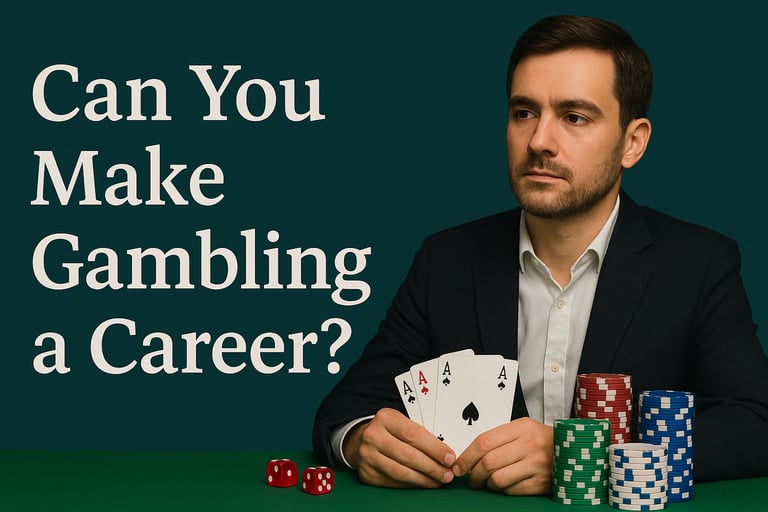
🏁 Final Thoughts: Can You Make Gambling a Career in 2026?
The short answer: yes, but only if you stop treating it like gambling.
In 2026, technology, data analytics, and discipline have turned gambling into something closer to financial trading. Yet 99% of players still lose because they treat it as a thrill, not a profession.
If you want to live under the Gamblinghood mindset, you must:
Think like a statistician.
Control your emotions.
Play the long game.
Focus on sustainability over glory.
Because in the end — and this remains timeless — a calm mind wins the race.
© 2026 All rights reserved.
Follow us
Quick Links