
He Lost His House, Family & Fortune… But Still Couldn’t Quit Gambling – The Dark Psychology No One Talks About
Even after losing money, relationships, and self-respect, many gamblers still refuse to stop. Discover the hidden psychology, brain science, and emotional traps that keep people gambling—even after total destruction.
AWARENESS
3/2/20265 min read
Why Even After Losing Everything, Gamblers Refuse to Stop
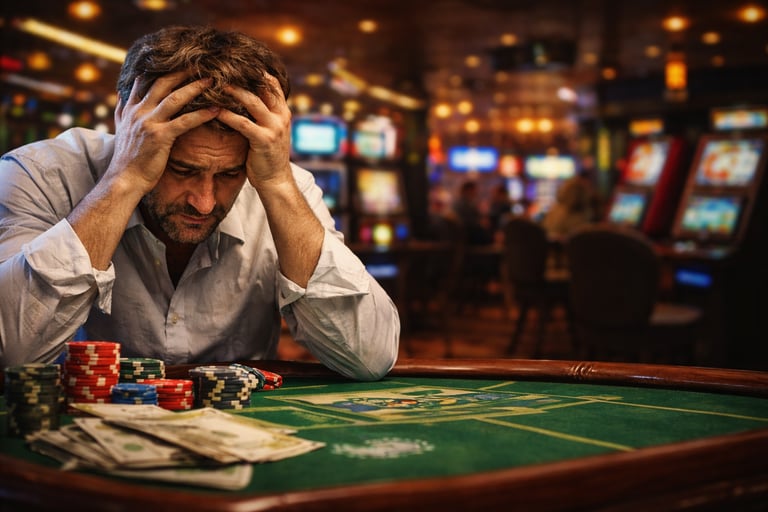
He lost his savings.
Then he lost his car.
Then he lost his house.
Then he lost the trust of the people who once believed in him.
But he didn’t stop.
If you’ve ever seen someone destroy their own life through gambling and still continue placing bets, you probably asked the same question:
“Why doesn’t he just quit?”
The answer is not weakness.
It’s not stupidity.
And it’s definitely not “just bad luck.”
It’s psychology. It’s neurobiology. It’s identity collapse. It’s addiction architecture.
Let’s break it down deeply.
Gambling Is Not About Money — It’s About Dopamine
Most people think gamblers are addicted to money.
They’re not.
They’re addicted to dopamine spikes.
Every time someone places a bet — whether in roulette, sports betting, or online casino games — the brain releases dopamine. Not when they win.
But when they anticipate winning.
That anticipation creates a powerful neurological loop.
Even when they lose, the brain says:
“Next time will be different.”
This is called variable reward conditioning — the same psychological principle used in slot machines, social media notifications, and video games.
The brain becomes wired to chase uncertainty.
And uncertainty becomes intoxicating.
The “Almost Won” Illusion
Casinos and betting systems are engineered to create near-miss outcomes.
The roulette ball lands one number away.
The slot machine shows two jackpot symbols and one slightly off.
The sports bet loses by just one goal.
These “almost wins” are devastating psychologically — because the brain processes them almost like real wins.
Instead of feeling defeat, the gambler feels:
“I was so close. I’ve figured it out.”
This strengthens the addiction rather than weakening it.
The Sunk Cost Trap: “I Can’t Stop Now”
One of the most dangerous psychological traps is the sunk cost fallacy.
After losing ₹1 lakh, the brain refuses to accept the loss.
Instead of stopping, it says:
“If I quit now, that money is gone forever. I need to win it back.”
So they gamble more.
Then they lose ₹2 lakh.
Now quitting feels even more painful.
The more they lose, the harder it becomes to stop — because stopping forces them to accept reality.
Continuing allows them to live in hope.
Hope feels better than acceptance.
Ego Destruction & The Need to Prove Something
Gambling is rarely just about profit.
It becomes about identity.
A man who once called himself a “smart bettor” cannot accept that he was wrong.
Admitting defeat means admitting:
I misjudged.
I was overconfident.
I’m not as sharp as I thought.
I failed.
For many people, especially men, ego pain is worse than financial pain.
So they keep betting — not to win money — but to win back self-image.
The Illusion of Control
In games like roulette, there is no skill.
In sports betting, there is limited predictive edge unless you are operating with professional data modeling.
But gamblers convince themselves:
“I understand patterns.”
“I’ve studied the team.”
“I can read momentum.”
“I know when to stop.”
This illusion of control makes quitting harder — because they believe success is just one adjustment away.
Emotional Escape: Gambling as Painkiller
Here’s something rarely discussed.
Many gamblers don’t gamble because they love risk.
They gamble because they’re avoiding something:
Stress
Loneliness
Career failure
Relationship problems
Self-doubt
When they gamble, the world disappears.
The spinning wheel, live score, flashing numbers — they create tunnel vision.
For a few hours, real problems don’t exist.
Even after losing everything, the gambling environment still offers emotional escape.
That’s powerful.
Shame Fuels the Cycle
When someone loses heavily, they feel shame.
Instead of asking for help, they hide it.
They lie.
They borrow money secretly.
They isolate themselves.
And isolation increases gambling — because gambling becomes the only “friend” left.
Shame doesn’t stop addiction.
It feeds it.
Losses Feel Temporary — Wins Feel Permanent
The human brain overvalues wins and minimizes losses.
After a big loss, a gambler thinks:
“This is temporary. I’ll recover.”
After a small win, they think:
“See? I’m capable. This is my comeback.”
They emotionally weight wins more heavily than losses.
So even if they’ve lost ₹10 lakh, they still emotionally anchor to that one ₹50,000 win from months ago.
That memory becomes proof of “potential.”
The Chase Phase: The Most Dangerous Stage
Psychologically, gambling addiction has phases.
The most destructive is the chasing phase.
This is when the gambler is no longer gambling for fun or profit.
They are gambling to erase previous losses.
Rational thinking collapses.
Bet sizes increase.
Risk management disappears.
Logic shuts down.
It becomes survival mode — but survival defined by recovering money.
And ironically, the deeper they go into chase mode, the less chance they have of recovery.
Why Logical Advice Doesn’t Work
Telling a gambler:
“Just stop.”
Is like telling a depressed person:
“Just be happy.”
Addiction rewires decision-making centers in the brain.
The prefrontal cortex — responsible for impulse control — weakens under stress and dopamine overload.
The emotional brain takes control.
This is why gamblers continue even when they intellectually understand they are destroying themselves.
The Social Media Illusion Makes It Worse
In today’s world, gambling is glamorized.
People see screenshots of big wins.
Influencers show luxury lifestyles funded by “trading” or betting.
Losses are hidden.
This creates false hope.
A gambler thinks:
“If they did it, I can too.”
They never see the thousands who lost everything quietly.
“I’ll Quit After One Big Win”
This is the most dangerous sentence in gambling psychology.
“I’ll quit after I recover everything.”
The problem?
When they finally hit a win, the brain says:
“Now I’m back. Let’s build more.”
They don’t quit.
Because the dopamine high convinces them they’ve regained control.
The Brain Actually Changes
Scientific studies show that gambling addiction activates the same neural pathways as drug addiction.
Over time:
Risk perception weakens.
Impulse control decreases.
Emotional regulation declines.
Stress tolerance drops.
This is why even after total financial collapse, the urge still feels overwhelming.
It’s not just habit.
It’s neurological conditioning.
The Family Impact: A Silent Collapse
When someone refuses to stop gambling:
Trust breaks first.
Then communication dies.
Then resentment grows.
Then isolation becomes permanent.
Yet even facing family destruction isn’t always enough to stop.
Why?
Because addiction narrows perspective.
Long-term consequences feel abstract.
Immediate bets feel urgent.
The brain prioritizes short-term dopamine over long-term survival.
The “I’m Different” Bias
Many gamblers believe:
“Most people lose. But I’m smarter.”
This bias is incredibly powerful.
Even after catastrophic loss, they believe they can become the exception.
Hope overrides statistics.
Can Someone Actually Stop?
Yes.
But not through fear alone.
Real recovery usually requires:
Complete financial cut-off
Self-exclusion from platforms
Therapy or addiction counseling
Rebuilding identity outside gambling
Honest social accountability
Stopping is not just quitting betting.
It’s rebuilding self-worth without risk stimulation.
The Real Reason They Don’t Stop
After losing everything, the gambler faces two unbearable truths:
I lost money.
I destroyed my own life.
Quitting forces them to sit with both.
Continuing gambling postpones that pain.
Even if it destroys them further, it delays self-confrontation.
And for many people, temporary emotional avoidance feels easier than permanent acceptance.
The Hardest Truth
Gambling addiction is not about greed.
It’s about:
Escaping pain.
Chasing identity.
Avoiding shame.
Fighting ego collapse.
Seeking dopamine.
Holding onto hope.
That’s why even after losing everything, some people refuse to stop.
Because stopping means facing reality without the chemical comfort of hope.
If You See This Pattern in Yourself
Ask yourself honestly:
Am I chasing losses?
Am I hiding bets?
Do I feel anxious when not betting?
Do I believe one big win will fix everything?
Am I gambling to feel alive?
If the answer is yes to multiple questions, the problem isn’t financial.
It’s psychological.
And psychology can be rewired — but only if acknowledged.
Final Thoughts
People who continue gambling after losing everything are not insane.
They are trapped in a loop engineered by:
Neurochemistry
Cognitive bias
Emotional avoidance
Ego defense
System design
Understanding this does not justify destruction.
But it explains it.
And explanation is the first step toward prevention.
Because the real danger of gambling isn’t losing money.
It’s losing the ability to stop.
If you found this deep dive insightful, reflect on it — not with judgment, but with awareness.
Sometimes the most dangerous addiction isn’t the one that looks destructive.
It’s the one that convinces you you're still one step away from winning everything back.
© 2026 All rights reserved.
Follow us
Quick Links