
How AI Can Increase Your Winning Chances in Gambling – Smart Players Are Using This Strategy in 2026
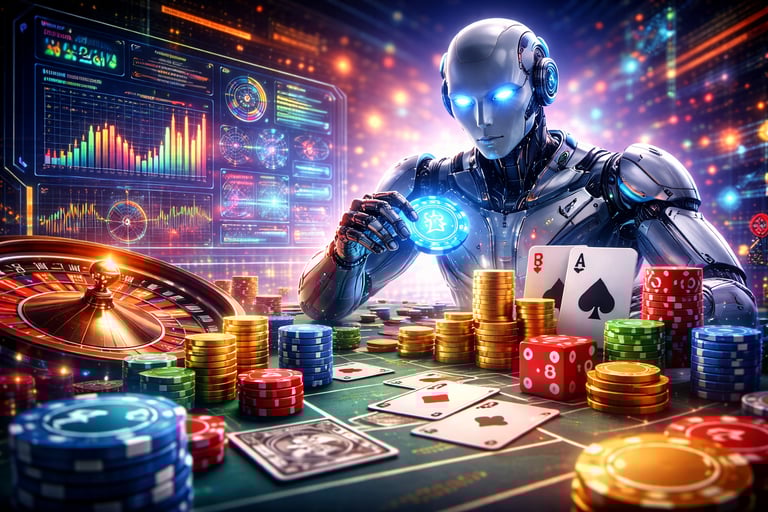
Artificial Intelligence is transforming sports betting, poker strategy, and online gambling analytics. From probability modeling to bankroll optimization, AI Can Increase Your Winning Chances in Gambling.
CASINO TIPS
2/22/20263 min read
How AI Can Help You in Gambling and Increase Your Winning Chances
Artificial Intelligence has entered nearly every industry — finance, healthcare, logistics, investing, and now gambling analytics.
But let’s be clear from the beginning:
AI cannot magically guarantee profits in gambling.
However, it can improve decision quality, reduce emotional bias, optimize risk management, and identify statistical inefficiencies — all of which can increase your probability edge over time.
Winning in gambling is not about luck alone. It is about probability management, variance control, and disciplined capital allocation. AI enhances those components.
This guide explains how.
Understanding the Core Problem in Gambling
Most gamblers lose because of:
Emotional decision-making
Chasing losses
Poor bankroll management
Ignoring mathematical probabilities
Overestimating short-term streaks
AI addresses these weaknesses by removing emotion and introducing statistical modeling.
1. AI for Probability and Pattern Analysis
In sports betting or poker, probabilities constantly shift.
AI models can:
Analyze historical data
Calculate win probability based on form and conditions
Detect betting market inefficiencies
Identify value bets
For example, in sports betting:
AI can evaluate:
Team form
Player injuries
Weather impact
Head-to-head data
Market odds movement
Instead of betting based on intuition, you rely on calculated expected value (EV).
Expected Value – The Real Edge
Professional gamblers think in Expected Value.
Expected Value formula:
EV = (Probability of Win × Win Amount) − (Probability of Loss × Loss Amount)
AI automates this at scale.
If EV is positive consistently, long-term profitability becomes statistically possible (though never guaranteed).
2. AI in Sports Betting Models
Advanced bettors use predictive modeling based on:
Regression analysis
Machine learning classification
Monte Carlo simulations
Neural networks
These models simulate thousands of outcomes before placing a bet.
For example:
Instead of guessing whether a football team will win, AI might simulate 10,000 game scenarios and determine:
54% win probability
Market odds imply 48% probability
That 6% discrepancy is potential value.
3. AI in Poker Strategy
Poker is partially skill-based.
AI can:
Analyze hand ranges
Suggest optimal betting sizes
Calculate pot odds instantly
Study opponent patterns
Modern poker solvers already use game theory optimal (GTO) strategies derived from AI computations.
Players using AI-based training tools can dramatically improve decision quality.
4. Bankroll Management Optimization
Many gamblers fail not because they are wrong often, but because they mismanage capital.
AI can recommend:
Optimal bet sizing (Kelly Criterion modeling)
Risk-adjusted stake allocation
Loss threshold protection
Variance smoothing
Example:
Instead of betting randomly sized amounts, AI calculates:
Optimal Bet % = Edge ÷ Odds
This prevents emotional overexposure.
5. AI for Emotional Control
Human psychology is the biggest enemy in gambling.
Common biases:
Gambler’s fallacy
Overconfidence bias
Recency bias
Tilt behavior
AI removes emotion from decision-making.
It only follows probability and data rules.
That alone significantly improves discipline.
6. Live Betting and Real-Time Analytics
Live betting markets fluctuate rapidly.
AI can track:
In-game momentum
Statistical performance metrics
Real-time possession data
Shot efficiency
Player fatigue
Instead of reacting emotionally, AI reacts mathematically.
7. Detecting Market Inefficiencies
Bookmakers set odds using algorithms — but markets are not perfect.
AI can detect:
Sudden odds shifts
Public bias-driven overreactions
Correlation mispricing
Arbitrage opportunities
However, arbitrage windows close quickly.
8. Limits of AI in Gambling
This is critical to understand:
Casinos build mathematical house edges
Slot machines and roulette use fixed probability systems
Random number generators cannot be predicted long-term
AI cannot defeat a house edge embedded in design.
If a game has negative expected value mathematically, AI cannot permanently reverse that.
Where AI helps most:
Skill-based games
Market-based betting
Probability modeling environments
9. Risk Management Reality
Even with AI:
Variance exists
Losing streaks occur
Market conditions shift
Models fail if data is poor
AI improves probability — it does not eliminate risk.
10. Ethical and Practical Considerations
Some gambling platforms restrict:
Automated betting bots
Algorithmic scraping
External model integrations
Always check platform policies.
The Strategic Mindset Shift
Successful gambling with AI requires:
Long-term thinking
Data discipline
Emotion control
Strict bankroll management
Accepting variance
Short-term wins are random.
Long-term edge is statistical.
Can AI Guarantee You Winning?
No.
But it can:
Improve probability assessment
Optimize bet sizing
Reduce emotional mistakes
Increase long-term decision quality
In probability-based environments, better decisions compound over time.
Who Benefits Most From AI in Gambling?
Sports bettors
Poker players
Fantasy sports participants
Quantitative betting enthusiasts
Not:
Casual slot players
Lottery buyers
Because pure chance games cannot be beaten long-term.
The 2026 Landscape
AI tools are becoming more accessible:
Predictive analytics dashboards
AI-assisted sports modeling tools
Poker training solvers
Statistical probability engines
The players using structured data will always outperform purely emotional gamblers over time.
Final Verdict
AI is not a cheat code.
It is a decision-enhancement system.
In gambling, the difference between losing and surviving often comes down to:
Risk control
Probability edge
Emotional stability
AI strengthens all three.
However, gambling remains risky and can lead to financial loss.
The smartest approach is to treat it as probability management — not guaranteed income.
If used correctly, AI can increase your strategic efficiency.
If misused, it changes nothing.
Discipline remains the real edge.
© 2026 All rights reserved.
Follow us
Quick Links