
How Gambling Sites Earn From You – GamblingHood Exclusive Breakdown
A deeply explained 2026 guide that reveals how gambling companies make money from players, how the system is designed to stay profitable, and the hidden mechanics behind casinos and betting platforms. Understand the strategies, psychology, and business model of gambling sites that ensure they always win in the long run.
AWARENESS
11/13/20256 min read
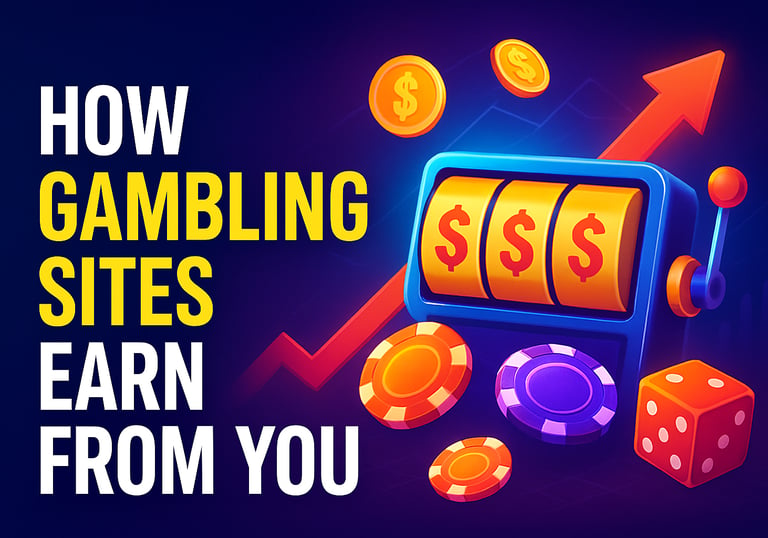
How Gambling Sites Earn From You
Gambling has always been presented as a thrilling world of possibilities — a place where anyone can get lucky, hit a jackpot, and walk away with life-changing money. But behind all the lights, sounds, offers, and excitement, there exists a powerful business machine. Gambling companies are not built on luck. They are built on mathematics, psychology, and carefully designed systems that ensure long-term profit.
Most players only see one side of the game: the reels spinning, cards flipping, dice rolling, and bets placing. But casinos see something else — predictable patterns, statistical edges, player emotions, and long-term revenue. This blog reveals how gambling platforms earn money from players, how the business works internally, and why the house always stays profitable no matter how many people win temporarily.
This GamblingHood exclusive exposes the real mechanics behind the gambling industry so you can understand the system much deeper than the average player.
The Hidden Structure of Every Casino Game
Every gambling game ever created — from blackjack to roulette to slots to sports bets — is built on a mathematical advantage known as the house edge. The house edge is small, invisible, and perfectly balanced so that players feel like they can win, but the casino earns steadily over time.
This edge ensures that even if players win today, tomorrow, or next week, the casino still wins across thousands of players and millions of bets. That is why casinos are not dependent on individual outcomes. Their business model relies on the law of large numbers. Over millions of bets, the small percentage advantage becomes massive profit.
Players believe they are battling luck, but in reality, they are participating in a statistical system that always favors the gambling site. This is the foundation of how casinos stay profitable 24/7, year after year, even during huge prize payouts.
The Psychology of the Player
Casinos earn more from emotions than from mathematics. Every button, color, sound, animation, and lighting inside a casino or online platform is designed to influence your mind. Nothing is accidental. The goal is to keep you playing longer — because the longer you play, the more the house edge works against you.
Excitement makes you ignore logic. Hope makes you risk more. Frustration makes you chase. Small wins make you believe you’re "getting close." Near misses make you feel you almost won. The entire environment is engineered to keep your brain in a loop of thrill, fear, anticipation, and reward.
In 2026, gambling platforms have perfected the art of psychological design. They use color psychology, sound triggers, reward systems, and fast gameplay speed to create emotional engagement. The emotions drive the behavior, and the behavior drives the casino’s revenue.
Small Wins, Big Losses — The Illusion of Progress
The biggest trick gambling sites use is the illusion of progress. They give players frequent small wins to create the feeling of success, but these wins are strategically controlled so the platform still remains profitable in the long run.
These small wins activate the brain's dopamine system. Even if the net result is a loss, the player feels entertained and motivated. Studies have shown that near misses — results where the player almost wins — trigger the same psychological response as an actual win. Casinos use this to keep players emotionally charged.
This subtle but powerful technique keeps players believing they can win back their losses or hit something big soon, even when mathematically the odds are working against them. This illusion is a major revenue driver for gambling companies.
The Power of Time — The Longer You Play, The More They Earn
Time is the casino's strongest weapon. The house edge does not guarantee they win every hour or every minute — but it guarantees they win over time. That’s why gambling platforms are designed to keep players engaged as long as possible.
In physical casinos, there are no clocks, no windows, no real sense of time passing. Online casinos use fast-paced gameplay where bets can be placed every few seconds. Sports betting platforms offer matches all day from around the world so players always find something to bet on.
The longer a player stays, the higher the chance they drift into emotional betting, exhaustion, or boredom — all of which reduce rational decision-making and increase losses. To the casino, time equals money.
Bonuses and Promotions — Not Gifts, But Traps
Bonuses look like rewards, but they are actually one of the most profitable systems for casinos. Every bonus comes with hidden conditions — wagering requirements, withdrawal limits, game restrictions, or minimum bet rules — designed to make players spend much more than they earn.
A bonus increases playtime, which activates the house edge more often. Even if players feel like they are getting something for free, the casino is ensuring that they must put more money in to unlock the bonus or withdraw any winnings from it.
In 2026, the bonus structure is more sophisticated than ever. Gambling platforms use bonuses to attract players, keep them active longer, and psychologically create the feeling of “free money.” In reality, the casino earns significantly more from players who accept bonuses compared to those who don’t.
Sports Betting Odds — The Silent Profit Machine
Sportsbooks are structured differently from casino games, but the business goal is the same: profit from long-term probability. The odds are calculated in a way that ensures the house holds a built-in margin regardless of the match outcome.
Even in markets where both sides are heavily bet on, the sportsbook adjusts odds to balance risk and maintain guaranteed margin. They rely on millions of bets to flatten variance.
In 2026, sportsbooks use advanced AI models to calculate odds instantly. These models analyze player statistics, match conditions, betting patterns, and thousands of hidden variables. This technology ensures the house advantage remains consistent across every market.
While players celebrate when they win, the sportsbook profits quietly in the background because the system is designed mathematically to make them winners long-term.
Player Behavior Tracking — The Modern Edge
Modern gambling websites collect massive amounts of data on player behavior. They track bet sizes, session length, reaction to losses, game choices, speed of clicking, emotional patterns, and more. This data helps them predict when a player is likely to spend more or take bigger risks.
Using this information, casinos personalize offers, messages, bonuses, and notifications to keep players engaged. What feels like convenience is actually a powerful profit system. The platform knows what triggers your excitement, what frustrates you, and what keeps you playing longer.
This level of behavioral tracking makes gambling companies extremely efficient at earning from players, especially in 2026 where AI models analyze user behavior in real-time.
The Danger of Chasing Losses
Chasing losses is the single biggest reason casinos earn huge profits from players. When someone loses money, they feel a psychological need to recover it. This emotional reaction blinds logic. Players begin placing larger bets, riskier bets, and more frequent bets — thinking they can “turn it around.”
Casinos rely heavily on this emotional trap. They know that many players break their own limits when they are trying to catch up. This leads to massive revenue for the platform. Profitable gamblers avoid chasing, but average players fall into this psychological cycle repeatedly.
This is one of the strongest financial engines for gambling companies.
The Illusion That “Someone Wins Big Every Day”
Casinos promote big winners everywhere. They highlight jackpots, show prize pop-ups, display massive payouts, and run advertisements with smiling winners. This creates a mental illusion that winning is common, easy, and achievable.
But behind the scenes, big wins are rare, statistically insignificant, and carefully highlighted to motivate millions of others to play. For every one big winner, thousands or even millions lose money. But the emotional effect of seeing someone win triggers hope — and hope is one of the most profitable emotions for gambling companies.
This illusion keeps players pouring money into games that are designed mathematically to make them lose.
Why “The House Always Wins” Is Actually True
The phrase isn’t just a saying; it's a business model. The house does not need to beat every player. The house simply needs probability and volume. Over thousands of bets, their mathematical advantage always becomes profit. That is why casinos stay open, grow bigger, offer more bonuses, spend millions on marketing, and still remain highly profitable.
Players win sometimes. Casinos win always.
Conclusion
Gambling sites don’t survive because of luck — they survive because of a deeply engineered business model. Every color, every sound, every animation, every bonus, every rule, every mathematical probability, and every psychological trick is designed to earn money from players.
The most profitable casinos are not the ones where players lose the fastest — they are the ones where players stay the longest, bet repeatedly, remain emotionally invested, and believe they can win again.
Understanding how gambling platforms earn money is the first step toward controlling your behavior and making smarter decisions. GamblingHood reveals these insights so that players can understand the real mechanisms at work and avoid falling into traps that most people never see.
© 2026 All rights reserved.
Follow us
Quick Links