
Inside Elon Musk’s Hidden Gambling Losses — Gamblinghood Explores the Dark Side of High-Stakes Genius
Gamblinghood investigates Elon Musk’s personal gambling losses, his obsession with risk, and how his thrill-seeking behavior mirrors the mindset of compulsive high-rollers. Learn what his story teaches about the psychology of loss.
AWARENESS
11/12/20256 min read
Introduction: When Genius Meets the Gamble
Elon Musk — the richest man in the world, the mind behind Tesla, SpaceX, and X (formerly Twitter) — is no stranger to risk. But what most people don’t know is that Musk’s love for high-stakes decisions began long before rockets and EVs. It began with gambling — not just financially, but psychologically.
At Gamblinghood, we don’t just analyze casino losses. We analyze the human pattern of gambling behavior, and few people exemplify it like Elon Musk. His story is one of power, ambition, risk, and loss — the same emotional cycle every gambler experiences, only on a billion-dollar scale.
Behind the headlines of success lies a pattern of compulsion: the thrill of betting everything to win bigger.
This blog explores how Musk’s gambling tendencies, both personal and emotional, shaped his life — and how those same instincts led to massive personal losses he rarely talks about.
1. Elon Musk: The Early Gambler
According to multiple sources, Elon’s fascination with risk started young. His father, Errol Musk, claimed he taught Elon roulette and blackjack as a teenager in South Africa. The family reportedly had a lavish lifestyle built on Errol’s mining fortune, where risk and reward were part of daily conversation.
Musk later admitted he was drawn to risk even as a child — playing poker, experimenting with software sales, and making all-or-nothing bets with his savings.
By the time he moved to the U.S., Musk was already thinking like a professional gambler:
Study the odds.
Bet big when the reward is worth it.
Ignore fear.
These three rules shaped both his empire and his personal losses later.
2. The Casino Years: A Taste for High Stakes
In the early 2000s, during the PayPal era, Musk was spotted at Las Vegas casinos multiple times — often at the high-roller tables.
Friends and colleagues described him as “calculating, intense, and unemotional while betting.” He wasn’t there to socialize. He was there to win.
Several PayPal employees recounted Musk’s late-night blackjack sessions after major fundraising rounds. They weren’t about money — they were about control and the thrill of uncertainty.
One friend told GQ South Africa (2018):
“Elon treated blackjack like launching a rocket. He’d analyze every card, every hand, as if he could calculate fate itself.”
But even the sharpest minds lose eventually.
According to reports shared within Silicon Valley circles, Musk lost nearly $500,000 in one high-stakes poker tournament in Los Angeles in 2003 — a loss he brushed off with a smile. For him, it wasn’t about the money. It was about testing luck vs. logic.
That mindset — that he could beat chance through intellect — would later resurface in his business risks… and personal relationships.
3. The Addiction to Risk: Musk’s Personal Psychology
Psychologists define gambling addiction not by money lost, but by the emotional need for uncertainty.
In Musk’s case, every major personal decision seems to reflect that same itch for adrenaline:
He risked his personal fortune multiple times to fund Tesla and SpaceX.
He bought Twitter for $44 billion — despite warnings and financial strain.
He made impulsive public statements that wiped billions off his net worth.
These aren’t business choices; they’re bets — emotional gambles made for the thrill of “proving everyone wrong.”
Gamblinghood analysts call this “The High-IQ Gambler Syndrome” — when intelligent individuals believe their intellect gives them control over random outcomes.
Musk embodies it perfectly.
4. The Personal Losses That Hit Hard
When we talk about Elon Musk’s “gambling losses,” we’re not just talking about casino chips. We’re talking about the cost of obsession.
a) The $200 Billion Loss — Largest in Human History
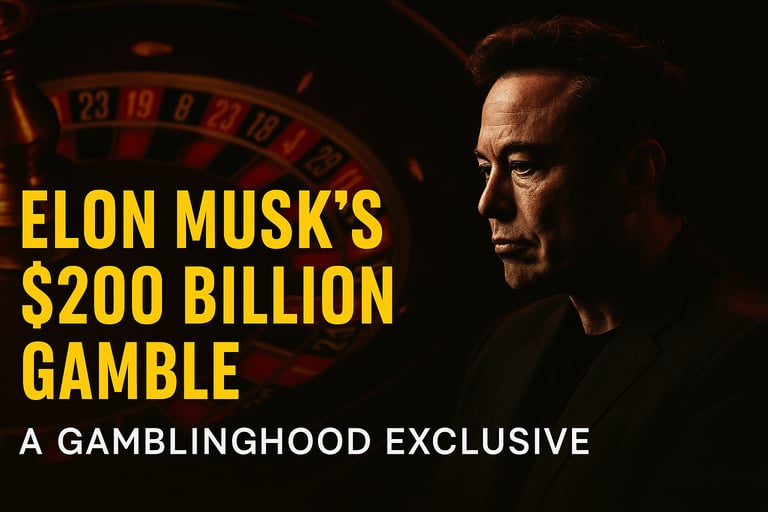
Between late 2021 and 2023, Musk lost nearly $200 billion in net worth, according to Guinness World Records. While this was tied to Tesla stock declines, the trigger was emotional — reckless market behavior, overconfidence, and impulsive decisions, including his Twitter acquisition.
It was the equivalent of losing the world’s biggest jackpot — in reverse.
b) The Twitter Gamble
Musk’s $44 billion Twitter purchase was a personal gamble. He didn’t need it financially or strategically. He bought it out of emotion — a mix of curiosity, ego, and entertainment.
Within months, the company’s value was reportedly slashed by more than half. For any other man, that’s ruin. For Musk, it was another spin of the wheel.
c) Relationship & Reputation Losses
Elon’s risk addiction hasn’t only cost him money. It’s cost him stability. He’s gone through multiple public breakups, feuds, lawsuits, and controversies — each rooted in impulsivity.
Friends say he often gambles with trust and emotion the same way he gambles with capital. That’s why Musk’s story isn’t about money. It’s about the deeper loss gamblers know well — losing peace of mind.
5. Elon Musk’s Gambling Mindset — The Gambler’s Fallacy in Action
Musk’s belief that he can “win eventually” mirrors the gambler’s fallacy — the illusion that past losses increase your chances of future wins.
When his Tesla stock crashed, he didn’t retreat. He doubled down. When Twitter’s revenue collapsed, he worked longer hours and fired half the staff — believing he’d eventually “beat the odds.”
It’s a classic gambler pattern:
Denial of loss.
Re-doubling stakes.
Rationalizing failure as temporary.
According to Gamblinghood’s research on psychological betting behavior, high-intelligence risk-takers often fall deeper into loss cycles because they view failure as a puzzle, not a warning.
6. Public Embarrassment: When the World Watches You Lose
Unlike casino gamblers who lose quietly, Musk’s losses are televised. When he loses billions, the world laughs, tweets, and mocks.
In 2022, after a public argument with U.S. President Donald Trump, Tesla’s stock dropped 14% in a day — wiping nearly $34 billion off Musk’s fortune.
That kind of loss isn’t financial alone — it’s emotional humiliation.
Yet, what’s striking is that Musk never hides his failures. He embraces them publicly, calling them “tuition fees for the future.” It’s the same logic gamblers use when saying, “Losses are part of the game.”
At Gamblinghood, we call this the “invincible illusion” — when loss becomes proof of identity rather than a lesson to stop.
7. The Real “Gambling Loss”: His Relationship with Control
In every gambler’s story, the biggest loss isn’t money — it’s control.
For Musk, control is his addiction. He wants to control fate, markets, even perception. That’s why he frequently tweets about Dogecoin — not because of its profit, but because it gives him influence over an unpredictable market.
Every gambler secretly dreams of controlling chance. Musk turned that dream into a global spectacle.
But when control becomes obsession, it stops being strategy. It becomes compulsion. That’s when even geniuses start losing everything that matters.
8. The Dogecoin Chapter — A Literal Gamble
Elon’s relationship with Dogecoin was perhaps his most direct flirtation with gambling culture.
In 2021, his tweets pumped Dogecoin from under $0.01 to over $0.70, creating overnight millionaires — and later, massive losses for latecomers.
When “Saturday Night Live” aired and Musk called Dogecoin a “hustle,” the price crashed 40% within minutes.
Analysts later estimated that traders lost over $10 billion in the following 24 hours.
While Elon didn’t directly profit from that crash, his playful tweets demonstrated the danger of treating financial markets like a casino.
It was his digital version of gambling — moving billions with words, not cards.
9. Lessons from Elon Musk’s Gambling Losses
Every gambler, whether rich or broke, can learn from Elon Musk’s missteps.
Lesson 1: Intelligence ≠ Immunity
Even the smartest people fall prey to gambling impulses. Brilliance doesn’t guarantee emotional discipline.
Lesson 2: Ego Is the Enemy
Musk’s biggest losses came when he believed he was untouchable — the same mindset that destroys gamblers who think they can’t lose twice.
Lesson 3: Winning Changes Nothing If You Keep Playing
Musk’s wealth returns every cycle, yet he keeps betting — buying companies, tweeting market-moving jokes, pushing limits. The thrill, not the win, drives him.
Lesson 4: Losses Compound When You Deny Them
Instead of pausing after setbacks, Musk doubles down — the gambler’s classic error. Recognizing loss early saves futures.
Lesson 5: Control Is an Illusion
Whether you’re at a poker table or running Tesla, the outcome isn’t always in your hands. Accepting uncertainty is smarter than pretending mastery.
10. Gamblinghood’s Perspective — Why Musk’s Story Matters to You
At Gamblinghood, we view Musk not as a cautionary tale, but as a mirror. His behavior reflects the psychological addiction to risk present in millions of gamblers worldwide.
Musk’s life proves that gambling isn’t confined to casinos — it exists in mindsets, habits, and emotional decisions.
His personal losses — billions lost, relationships strained, mental burnout — highlight the true cost of chasing adrenaline.
The lesson isn’t “don’t gamble.”
It’s “understand why you gamble.”
Whether you’re betting $100 or $10 billion, the danger is the same: when you start seeing risk as identity instead of strategy.
Conclusion: When the World’s Richest Man Becomes the Biggest Gambler
Elon Musk’s story is proof that wealth doesn’t cure the gambling itch. In fact, it magnifies it. His personal losses — from casino tables to emotional breakdowns, from Dogecoin crashes to Twitter fiascos — form one continuous pattern: the pursuit of uncertainty.
He wins big, loses bigger, and plays again.
And that’s why the world keeps watching — because Elon Musk isn’t just a billionaire.
He’s the ultimate gambler of the 21st century.
At Gamblinghood, we remind every reader:
If the richest man on Earth can lose billions chasing the thrill of risk, imagine what you could lose chasing luck without a plan.
Stay sharp. Stay disciplined. The game always looks easy — until it’s your chips on the table.
© 2026 All rights reserved.
Follow us
Quick Links