
The Truth About Stake Games: How Plinko and Crash Are Designed to Make You Lose – Gamblinghood 2026
Stake games like Plinko, Crash, Dice, and Mines promise excitement — but in reality, they’re engineered for loss. Gamblinghood’s 2026 guide reveals how these games manipulate odds, psychology, and profit systems to keep players hooked and losing.
CASINO GAMES
10/26/20257 min read
The Truth About Stake Games: How Plinko and Crash Are Designed to Make You Lose (2026 Gamblinghood Guide)
The digital casino world exploded between 2020 and 2026. Online platforms like Stake, Rollbit, and Duelbits made gambling accessible to anyone with a smartphone and Wi-Fi connection. Streamers made it look fun, influencers promoted it as “easy money,” and thousands of people joined every day — chasing that one big win.
But beneath the flashing colors and quick wins hides a harsh truth: stake games are built to make you lose.
Games like Plinko, Crash, Mines, and Dice aren’t random fun. They’re mathematical traps that feed your dopamine while draining your balance — one “almost win” at a time.
In this 2026 Gamblinghood exposé, we break down exactly how these games are engineered, why they’re addictive, and how you can protect yourself before they take more than just your money.
1. The Rise of Stake and “Entertainment Gambling”
Once upon a time, casinos were places you physically entered. There were chips, cards, and the sound of slot machines. Today, all that happens on your phone.
Platforms like Stake.com reinvented gambling by mixing entertainment, fast gameplay, and influencer culture. Watching your favorite YouTuber hit a “10x” on Plinko feels exciting — even if you don’t realize the math behind it.
These games are called “provably fair”, meaning outcomes can be verified mathematically. But “fair” doesn’t mean “favorable.” The system doesn’t cheat — it simply tilts the odds so that, over time, the house always wins.
Let’s look at how that works.
2. Plinko: The Illusion of Choice
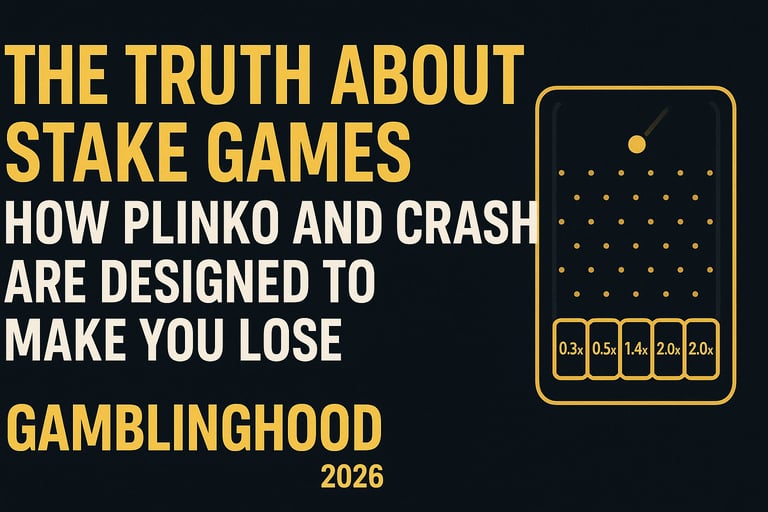
Plinko is one of the most popular stake games. A ball drops from the top of a triangle board, bouncing off pins until it lands in a multiplier slot below. The game looks simple, fair, and random.
But here’s the secret:
The high multipliers (like 100x or 1,000x) have tiny probabilities. You might have a 0.001% chance of hitting them.
The low multipliers (like 0.3x or 0.5x) show up most of the time.
Over hundreds of drops, you’ll average a return-to-player (RTP) of about 96% — meaning for every ₹100 you bet, you’ll lose ₹4 on average.
That 4% may not sound like much. But multiply it over thousands of rounds, and you’ll see how the system bleeds players dry.
The design is genius — you feel in control, choosing “risk levels” or “rows.” But all that choice is illusion. The algorithm is built to distribute wins strategically, giving small payouts early, then draining steadily.
3. Crash: The Perfect Psychological Trap
Crash is the poster child of modern gambling. A rocket takes off, the multiplier rises — 1.2x, 2x, 10x — and you have to cash out before it “crashes.”
Simple? Yes. Fair? Not quite.
Crash uses variable reward schedules, the same psychological principle that makes slot machines addictive. Sometimes you win early, sometimes late, but you never know when.
This unpredictability creates dopamine spikes — small wins make you feel like you’re mastering the system, even though every crash is pre-coded to favor the house.
Let’s break it down:
The house sets a theoretical RTP (95–97%).
Every crash point is determined after you place your bet.
The system ensures that, across thousands of rounds, average losses match the house’s profit model.
Crash looks skill-based, but it’s pure luck wrapped in timing pressure. It preys on your instincts — greed, fear, and hope — and turns them into predictable revenue.
4. Mines: The Illusion of Control
Mines is another Stake favorite. You choose how many mines (like bombs) are hidden in a grid and click tiles to uncover multipliers. The more safe tiles you uncover, the higher your payout — but hit a mine, and you lose everything.
The psychology is brilliant. Mines gives you an illusion of control — you pick tiles, you decide risk, you choose how long to continue.
But in truth, every click is just another dice roll. The RTP again sits below 97%, and no strategy can override the built-in odds.
Even when you win small, the game tempts you to “go one more round.” That extra click is how it takes back your winnings.
Every “safe click” builds your confidence until one wrong step wipes it all away. That’s not bad luck — that’s design.
5. Dice, Limbo, and the Math of Loss
Old-school gamblers love Dice — you pick a number and bet on whether the roll will be higher or lower. Modern versions like Limbo on Stake follow the same logic.
The mathematics are crystal clear here:
You can bet on high multipliers (rare hits) or low ones (frequent but smaller wins).
The payout is always slightly less than the true probability would pay — that’s the house edge.
For example:
If your true chance of winning is 50%, your payout should be 2x. But Dice pays around 1.98x — that 0.02x difference is how the casino profits.
Over thousands of rolls, that 1–3% edge compounds, ensuring the platform’s profitability and your eventual loss.
6. Why These Games Feel “Fair”
The brilliance of stake games lies in how they’re presented. Transparent, colorful, interactive — they feel fairer than traditional slots or blackjack.
Here’s how the illusion works:
Provably fair systems let you verify outcomes, but they don’t stop losses.
Streamers show massive wins, rarely their huge losses.
Fast rounds make you forget time and money spent.
Small wins reinforce the illusion of progress, keeping you hooked.
You’re never scammed — but you’re mathematically managed.
It’s not cheating. It’s business.
7. Streamers and the Manipulation of Perception
Between 2021–2026, online gambling influencers became the industry’s golden promoters. Streamers on Twitch, Kick, and YouTube would play games like Plinko and Crash live, showing thrilling moments of massive wins.
But here’s the untold truth:
Many use sponsored balances — they’re not risking their own money.
Some even play on fake demo modes, prearranged for big wins to attract viewers.
Their job isn’t to show real gambling — it’s to make you gamble.
When you see a streamer win $50,000 on Plinko, your brain doesn’t process probability — it processes possibility. You think, “Maybe I can do that too.”
That’s the emotional hook that Stake and similar sites rely on.
8. The Psychology Behind Losing
When you start losing, something strange happens in the brain. Instead of walking away, your mind tries to restore balance.
It tells you:
“Just one more spin, one more drop, one more round — you’ll recover.”
This is called loss chasing, and it’s the most destructive habit in gambling.
Each loss increases emotional intensity. You stop analyzing and start reacting. At that point, the game isn’t about money anymore — it’s about ego and control.
Stake-style games are built to exploit exactly that emotional shift. They offer instant rematches, auto bets, and quick deposit options — ensuring you can keep chasing without ever stopping to think.
9. Why the House Always Wins — No Matter What
You’ve probably heard the phrase: “The house always wins.” It’s not just a saying — it’s a mathematical truth.
Every stake game has a House Edge, even if it’s just 2–4%. That means:
On average, for every ₹100 wagered, ₹96–₹98 is returned to players.
The remaining ₹2–₹4 becomes profit for the casino.
That doesn’t sound big — until you scale it. Across millions of bets, that edge earns casinos millions daily.
Even if some players win huge, the system is designed so that the total payout is always lower than the total wagered.
It’s not luck. It’s structure.
10. How to Protect Yourself in 2026
If you’re gambling online, awareness is your strongest shield. Here’s how to stay smart and safe:
Set a hard limit – Decide your loss limit before you start, and stick to it.
Never chase losses – Once you’re down, walk away. There’s no “getting even.”
Understand the math – Every stake game is negative EV (expected value).
Don’t believe influencers – Streamers are marketing, not role models.
Take breaks – Casinos design for speed; slowing down breaks their rhythm.
Separate fun from profit – Treat it like paying for entertainment, not investment.
If you gamble for fun, fine — but never confuse it with a way to earn.
11. The Gambler’s Fallacy
Another dangerous mindset is believing in “due luck” — that after a losing streak, a win must be coming.
That’s false. Each bet is independent. If you lose 10 times in a row on Plinko, your next drop is still subject to the same probability.
Casinos know players fall for this. That’s why they show “Recent Wins” and “Big Hits” on screens — to trick you into thinking the next one could be yours.
In reality, luck has no memory.
12. Addiction in the Age of Fast Gambling
2026 has seen a shift from slow, traditional betting to micro-gambling. Games like Crash and Dice last seconds, meaning you can lose hundreds in minutes.
This pace creates an intense dopamine feedback loop — short highs followed by crushing lows. Your brain adapts to the pattern and starts craving the feeling of risk itself.
Soon, you’re not even playing for money. You’re playing to feel alive.
That’s when gambling crosses the line from fun to addiction.
13. The Responsible Player’s Mindset
Real strength isn’t about winning more — it’s about knowing when to stop.
Smart players in 2026 follow one rule:
“Control the game before the game controls you.”
Gamblinghood promotes a responsible mindset where education beats temptation. Knowing how these systems work gives you power — the power to choose wisely.
Enjoy the thrill, but remember: the house writes the rules.
14. Why Gamblinghood Exists
Gamblinghood was built to educate, not encourage. Our mission is to expose the truth behind modern gambling systems, so players can make informed choices.
In 2026, when digital casinos flood social media with flashy wins and fake influencers, Gamblinghood stands for transparency and awareness.
We believe that understanding the psychology and math behind gambling can save lives, money, and mental health.
15. Final Thoughts – The Game You Can’t Win
Stake games like Plinko, Crash, Dice, and Mines are beautifully designed. They’re colorful, fast, exciting — and mathematically unbeatable.
You can win in the short term, but the system is engineered for your long-term loss. Every design element — from music to color to cash-out timing — is built to keep you almost winning.
Remember: when you play against math, math always wins.
So, if you’re stuck chasing those flashy multipliers in 2026, pause and ask yourself —
“Am I really playing to win, or am I just being played?”
Be smart. Be aware. Be a Gamblinghood.
© 2026 All rights reserved.
Follow us
Quick Links