
Trump’s Taj Mahal Casino Story: The Indian-Inspired Empire That Gambled It All
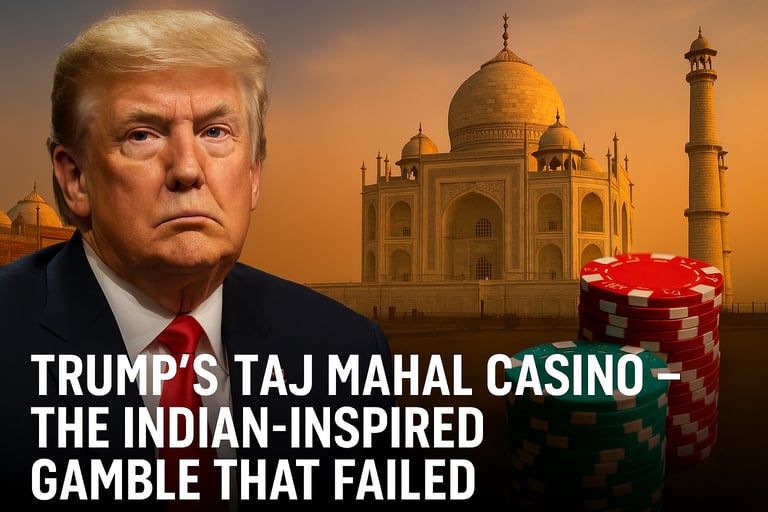
Did you know Donald Trump once built a casino named after India’s Taj Mahal? Gamblinghood uncovers how Trump’s “Taj Mahal Casino” rose in glory and collapsed in debt — a story of luxury, obsession, and downfall.
AWARENESS
11/11/20257 min read
Trump’s Taj Mahal Casino Story: The Indian-Inspired Empire That Gambled It All
When you hear the name Taj Mahal, you imagine India’s white marble masterpiece — a symbol of love, beauty, and eternity.
But in the 1990s, on the shores of Atlantic City, USA, another Taj Mahal rose — one not built by an emperor, but by a businessman chasing glory: Donald J. Trump.
Trump called it the “Eighth Wonder of the World.”
It was a casino so extravagant, so golden, and so ambitious that it carried the name of India’s most iconic monument — the Trump Taj Mahal.
For a while, it dazzled America’s elite. But behind the bright lights and slot machines was a darker truth — one of crushing debt, broken promises, and a gambler’s dream that went too far.
This is the full story of how Donald Trump’s Taj Mahal Casino, inspired by India’s crown jewel, became one of the biggest failures in U.S. casino history.
And how, ironically, it mirrors the same high-risk addiction that Trump himself couldn’t walk away from.
Welcome to Gamblinghood’s deep dive into the Indian-inspired casino that gambled it all.
1. The Birth of an “American Taj Mahal”
It was the late 1980s — a golden era for American casinos. Atlantic City was booming, and Donald Trump was already the city’s king of glitz.
He owned the Trump Plaza and Trump Castle, but he wanted something that would outshine every casino in Las Vegas.
When construction began on the Trump Taj Mahal Casino Resort in 1988, Trump declared:
“It will be the greatest casino in the world — a place so grand, even the real Taj Mahal would be jealous.”
The name itself was a marketing stroke of genius.
India’s Taj Mahal was globally recognized as a monument of love and perfection.
By borrowing its name, Trump wasn’t just building a casino — he was building a symbol of global power and luxury, one that could attract the rich from every continent, including India.
The architectural design echoed its Indian namesake — domes, arches, and golden accents throughout the halls.
But instead of love stories and poetry, this Taj Mahal told a story of risk, power, and addiction.
2. Opening Day: A Monument of Wealth
On April 2, 1990, Trump’s Taj Mahal opened its golden doors.
It cost over $1 billion — the most expensive casino ever built at the time.
There were 4,000 rooms, 120,000 square feet of gaming space, 70 restaurants, and 18-karat gold leaf ceilings.
Celebrities flooded in.
Michael Jackson made appearances, champagne flowed endlessly, and the media dubbed it “Trump’s crown jewel.”
Even Indian tourists visiting the U.S. would stop by Atlantic City just to see it.
It was marketed globally, and many in India saw it as a strange but impressive tribute to the real Taj Mahal — a piece of Indian pride standing tall in America.
For a while, it worked.
The casino pulled in record-breaking numbers.
Trump boasted:
“It’s impossible for this place to fail. This is the eighth wonder of the world.”
But, as the world would soon learn, the “American Taj Mahal” was built not on marble — but on mountains of debt.
3. The Debt Behind the Glamour
Trump borrowed nearly $800 million to build the casino, mostly from junk bonds — high-interest, high-risk loans.
He promised investors that the Taj Mahal would pay off its debts within a year.
But within months of opening, the casino started struggling.
The operating costs were enormous, and Atlantic City’s gambling boom was slowing down.
To stay afloat, Trump needed over $1 million a day just to cover interest payments.
That’s when the losses began.
According to Gamblinghood research, the Taj Mahal earned roughly $280 million in revenue during its first year but owed $340 million in expenses — a net disaster.
Trump’s empire started collapsing under its own weight.
By 1991, the unthinkable happened — the Taj Mahal went bankrupt.
It was the first in a series of four casino bankruptcies that would later define Trump’s risky financial legacy.
4. Why It Was Named “Taj Mahal” — The Indian Connection
Many have wondered: Why did Donald Trump choose the name “Taj Mahal”?
According to his early interviews, he wanted a name that symbolized ultimate luxury and eternal beauty.
The real Taj Mahal of India represented the height of human achievement and global fascination.
By naming his casino after it, Trump hoped to evoke the same sense of opulence and immortality — and attract international attention, especially from wealthy visitors from Asia and the Middle East.
However, critics argued it was a form of commercial exploitation.
They saw it as Trump taking one of India’s most sacred monuments of love and turning it into a gambling palace — something far from the Mughal emperor Shah Jahan’s vision.
Indian newspapers in the early 1990s even reported mixed reactions.
Some admired the grandeur; others saw it as a symbol of Western greed and excess.
Still, for millions of Indians fascinated by the West, the Trump Taj Mahal became a topic of curiosity — “a casino with our name on it.”
5. The Addiction Behind the Business
The Taj Mahal casino didn’t just reflect Trump’s ambition.
It reflected his addiction to risk and spectacle — the same psychological pattern found in gambling itself.
Every business move was treated like a bet.
Every loan was another roll of the dice.
Gamblinghood analysts note that Trump’s management of the casino mirrored compulsive gambler behavior — believing that one big win could erase all losses.
Instead of scaling back, he borrowed more, expanding his debts to finance additional projects.
In gambling terms, Trump was “chasing his losses.”
6. The Taj Mahal’s Fall — A Monument to Failure
By the mid-1990s, Trump was drowning in over $3 billion in debt.
The Taj Mahal casino filed for bankruptcy again in 2004 and 2009 under new corporate names, but the brand “Trump Taj Mahal” survived — for a while.
In 2016, workers went on strike over unpaid benefits and poor conditions. The casino finally shut down that same year.
The so-called “Eighth Wonder of the World” closed its doors after 26 years of operation.
Ironically, 2016 was also the year Trump won the U.S. presidency.
While one chapter of his casino empire ended, another gamble — political power — began.
7. What Indians Thought of Trump’s Taj Mahal
In India, the story of the Trump Taj Mahal fascinated people for decades.
For some, it was seen as a symbol of Indian influence abroad — that even the world’s most famous businessman named his greatest casino after India’s monument of love.
For others, it was seen as irony at its finest — the real Taj Mahal stood for devotion and purity, while Trump’s version stood for greed and gambling.
Many Indian media outlets revisited the story after Trump’s election win, comparing the two Taj Mahals:
One built for love.
One built for luck.
And both became world-famous — but for very different reasons.
8. From Casino to Crypto: Trump’s New Bets
Today, the Trump Taj Mahal casino no longer exists.
It was sold to Hard Rock International, which rebranded it as the Hard Rock Hotel & Casino Atlantic City in 2018.
But Trump’s gambling spirit lives on — just in new forms.
He has publicly embraced Bitcoin and crypto, calling them “modern forms of value and freedom.”
Gamblinghood analysts argue that crypto trading attracts the same psychology as casino gambling — high risk, high reward, and dopamine-driven volatility.
In that sense, Trump hasn’t really quit gambling.
He’s just changed tables.
9. Lessons from Trump’s Taj Mahal Casino
The rise and fall of the Trump Taj Mahal is more than a story about business. It’s a metaphor — about ambition, addiction, and illusion.
Here are Gamblinghood’s takeaways:
Luxury Doesn’t Guarantee Profit:
The Taj Mahal casino had the best architecture and celebrities but couldn’t escape the math of bad debt.Borrowed Success Is Temporary:
Like many gamblers, Trump built wealth using other people’s money — and paid the price later.Glamour Can Hide Addiction:
Behind the gold doors and crystal chandeliers was a man who couldn’t stop betting.Every Monument Has a Weak Foundation If Built on Ego:
The Taj Mahal in India was built on love; Trump’s was built on loans. One still stands centuries later.
10. The Symbolism: Two Taj Mahals, Two Worlds
It’s poetic that Trump chose the name “Taj Mahal.”
The real Taj Mahal in Agra is silent, spiritual, and eternal — a symbol of love conquering time.
The Trump Taj Mahal in Atlantic City was loud, material, and temporary — a symbol of greed consuming itself.
One represents emotion.
The other represents ego.
In many ways, the story of Trump’s casino is not just about business — it’s a reflection of the modern world’s obsession with instant gratification and fame.
While India’s Taj Mahal attracts millions seeking peace and beauty, Trump’s Taj Mahal became a tourist attraction for a different reason — as the world’s most famous failed casino.
11. Gamblinghood’s Final Analysis: The Gamble That Defined a Legacy
Donald Trump’s Taj Mahal wasn’t just another casino — it was his identity project.
He poured his ambition, pride, and obsession into it, using the Indian name as a symbol of global dominance.
But it became a cautionary tale.
Trump’s downfall through the Taj Mahal casino perfectly mirrors the core truth of gambling psychology:
The moment you think you can’t lose, you’ve already lost.
Even after bankruptcy, Trump continued to call it a “success,” saying,
“The Taj Mahal was an amazing building — it just needed better luck.”
But luck doesn’t sustain empires.
Numbers do. And those numbers were stacked against him from day one.
Conclusion: A Monument Built on Risk, Not Marble
Trump’s Taj Mahal casino was born from a dream — the dream of creating the world’s most luxurious gambling destination, inspired by India’s most beautiful monument.
But instead of standing as a monument to love and legacy, it became a monument to risk and ruin.
For India, the real Taj Mahal remains an eternal symbol of devotion.
For America, the Trump Taj Mahal remains a lesson in hubris — how even the richest man can gamble everything and lose.
In the end, Donald Trump didn’t just build a casino.
He built a mirror reflecting the danger of living life like a game of chance.
And that’s why, even decades later, the story of the “American Taj Mahal” continues to fascinate the world — especially the nation whose name it borrowed.
© 2026 All rights reserved.
Follow us
Quick Links