
What Happens in Your Brain After a Big Gambling Loss – Explained Simply with Real Psychology
What happens in your brain after losing money in gambling? Discover the real psychology, emotional triggers, and why it becomes hard to stop.
AWARENESS
3/27/20261 min read
The Moment That Changes Everything
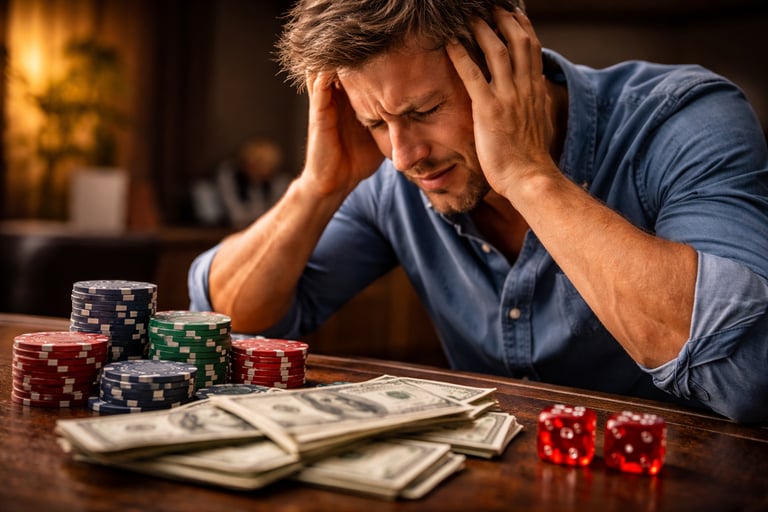
Right after a big loss, something shifts instantly.
Your heart rate increases
Your focus narrows
Your emotions take over
At that moment, you are no longer thinking logically.
You are reacting.
Your Brain Goes Into “Recovery Mode”
After losing money, your brain tries to fix the situation.
It tells you:
Win it back
Play again
Take one more chance
This is not logic.
This is a survival response.
Dopamine Drop and the Urge to Continue
Before losing, your brain releases dopamine during play.
After losing:
dopamine drops suddenly
This creates discomfort.
To fix it, your brain pushes you to:
keep playing
seek another win
This is why stopping feels difficult.
Why Loss Feels More Powerful Than Win
Psychology shows:
Losses feel 2 times stronger than gains
So when you lose:
you feel pressure
you feel urgency
you feel the need to recover
This leads to bad decisions.
The “Near Win” Trap
Almost winning is more dangerous than losing clearly.
Because your brain thinks:
I was close
This increases motivation to continue.
Even though mathematically,
nothing has changed.
Your Brain Starts Ignoring Risk
After a loss:
you focus on winning
you ignore probability
you underestimate risk
This creates dangerous behavior:
higher bets
faster decisions
less control
Emotional Decision Loop
After loss, this loop begins:
loss → emotion → action → more loss
Each step reduces rational thinking.
Why You Feel You Can Still Win
Your brain remembers:
past wins
big moments
positive experiences
It ignores:
total losses
long-term results
This creates false confidence.
The Illusion of Control
You feel like:
I can control this
I understand the game
But in reality:
outcomes are random
house edge is fixed
Control is an illusion.
What Breaks This Cycle
Only one thing:
stopping immediately
Time reduces emotional intensity
and brings logic back.
Real Data Insight
Most gamblers continue playing after a loss
Chasing losses increases total loss significantly
Emotional decisions are highest right after losing
The Real Truth
After a loss, your brain is not working in your favor.
It is trying to:
fix pain
recover quickly
escape discomfort
But this leads to deeper loss.
Final Verdict
The moment after a loss is the most dangerous moment in gambling.
If you understand your brain,
you understand your behavior.
And if you control that moment,
you protect everything.
© 2026 All rights reserved.
Follow us
Quick Links