
Why Gambling Lets You Win Early — Then Takes Everything Back Over Time
Gambling Lets You Win Early wins before long-term losses begin. This deep analysis explains the psychological traps, house edge mechanics, and behavioral patterns that cause gambling to turn against you over time.
CASINO GAMES
1/22/20263 min read
Introduction
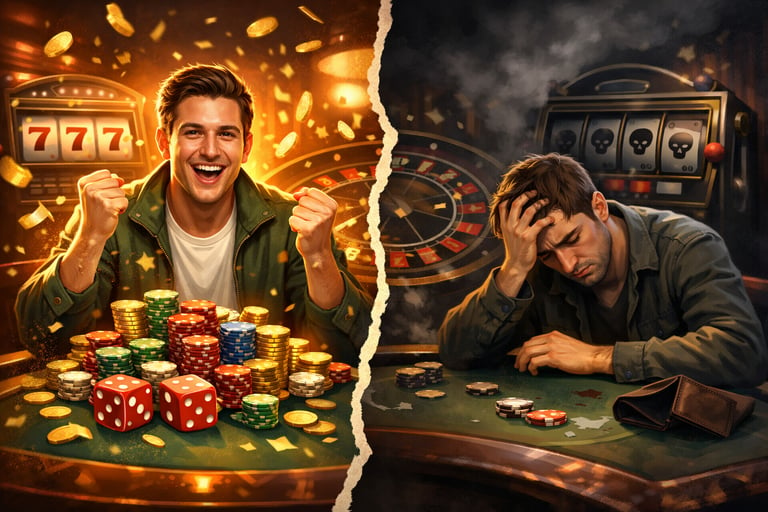
One of the most confusing and emotionally damaging experiences in gambling is this: you win at the beginning, sometimes even big — and then you start losing consistently over time.
This pattern is so common that many gamblers believe it is coincidence, bad luck, or even personal failure. In reality, it is neither random nor accidental. Early wins are not only expected — they are structurally embedded into how gambling systems work.
Platforms and awareness initiatives such as Gamblinghood have long emphasized that early success is often the entry point into long-term loss. To understand why this happens, we must examine game design, probability, psychology, and human behavior, not superstition.
This article explains why gambling rewards you first — and why it almost always turns against you with time.
The Early Win Is Not Luck — It Is Design
Gambling Systems Are Built for Engagement, Not Fairness
Casinos, betting platforms, and online gambling products are businesses. Their primary goal is not to beat you immediately — it is to keep you playing.
Early wins serve several purposes:
They build emotional attachment
They create confidence
They reduce fear of loss
They establish belief in “skill” or “intuition”
If most players lost instantly, they would quit. Early wins are the hook, not the reward.
The House Edge Never Goes Away
Why Probability Always Turns Against You
Every gambling game contains a house edge — a mathematical advantage that guarantees the operator profits over time.
Key point:
Short-term outcomes can favor the player
Long-term outcomes always favor the house
Early wins happen within statistical variance, but as the number of bets increases, results converge toward the house edge.
This means:
The longer you play, the closer your outcome moves toward loss
Time is the enemy of the gambler, not bad luck
The Beginner’s Luck Illusion
Why Your First Wins Feel “Special”
Early wins create a powerful psychological distortion known as illusory control.
Gamblers start believing:
“I understand the game”
“I can read patterns”
“I know when to stop”
“I am different from others”
In reality, early wins inflate confidence without increasing skill, leading to larger bets and longer sessions — exactly what the system wants.
Dopamine Conditioning: Your Brain Is Being Rewired
Gambling Trains the Brain to Chase Rewards
Each win releases dopamine — the same neurotransmitter involved in addiction, motivation, and desire.
Over time:
Small wins stop feeling exciting
Losses feel intolerable
The brain craves the emotional high of winning again
This leads to:
Riskier bets
Longer play sessions
Ignoring logic and probability
The gambler is no longer playing to win money — they are playing to relieve emotional discomfort.
The Escalation Trap: From Control to Compulsion
Why Betting Size Increases Over Time
Early wins give gamblers confidence to increase stakes.
Typical progression:
Small bets → early success
Confidence grows → bigger bets
Losses appear → attempt to recover
Emotional decisions replace logic
This escalation dramatically increases the impact of losses while the house edge remains unchanged.
Loss Chasing: The Point of No Return
Why Losses Multiply After Early Wins
Once a gambler starts losing, a dangerous behavior often emerges: loss chasing.
Loss chasing occurs when:
You believe one more win will “fix everything”
You refuse to accept a loss emotionally
You keep playing despite knowing the odds
At this stage, gambling is no longer entertainment — it becomes psychological self-negotiation.
Why Gambling Feels Predictable at First
Randomness Creates False Patterns
Human brains are pattern-seeking machines. In random systems:
Coincidences feel meaningful
Short streaks feel predictive
Losses feel temporary
Early wins reinforce the illusion that outcomes are controllable, even though randomness does not care about memory or fairness.
Time Is the Casino’s Greatest Weapon
Why “Just Playing Longer” Guarantees Loss
Every additional bet:
Increases exposure to the house edge
Reduces the impact of variance
Moves results toward mathematical expectation
This is why:
Some people win on day one
Almost nobody wins long-term
Winning early is possible. Winning forever is not.
Emotional Fatigue and Decision Degradation
Why Judgment Gets Worse Over Time
As sessions extend:
Emotional fatigue sets in
Risk tolerance increases
Discipline collapses
Late-session decisions are:
Faster
Riskier
Less rational
This is not a character flaw — it is a neurological response to stress and dopamine depletion.
Why Gambling Success Is Unsustainable
Even professional gamblers rely on:
Strict limits
External discipline
Short sessions
Statistical edges unavailable to casual players
Without these controls, the average gambler is statistically guaranteed to lose.
The Final Truth Most Gamblers Learn Too Late
Early wins are not proof of skill.
They are permission slips to keep playing.
Gambling does not beat you by force.
It beats you by time, emotion, and mathematics.
Conclusion: Winning Early Is the Trap, Not the Prize
If you have ever wondered why gambling felt easy at first and brutal later, the answer is simple and uncomfortable:
It was designed that way.
Early wins build belief.
Time erodes advantage.
Emotion replaces logic.
Loss becomes inevitable.
Understanding this pattern is the first step toward breaking it.
© 2026 All rights reserved.
Follow us
Quick Links