
Why Most Gamblers Lose Their Winnings in the End — The Hidden Psychology That Drains Your Money
Millions win money in gambling — but almost all Gamblers Lose Their Winnings. Discover the psychological traps, casino math, and emotional triggers that cause gamblers to lose their winnings in the end.
AWARENESS
2/12/20265 min read
Why Most Gamblers Lose Their Winnings in the End
Winning feels powerful.
It feels like proof that you're smarter than the system. That you cracked the code. That luck is finally on your side.
But here is the uncomfortable truth:
Most people who win in gambling eventually lose those winnings — and often much more.
This is not just bad luck. It’s not just “lack of discipline.”
It’s a predictable pattern driven by psychology, probability, and behavioral economics.
Let’s break it down precisely.
1. The House Edge: Mathematics Always Wins
Before discussing emotions, we need to talk about math.
Every casino game — whether it’s slots, roulette, blackjack, sports betting, or online crypto casinos — is designed with a house edge.
That edge guarantees that over time, the casino wins.
For example:
Slot machines: 2%–15% house edge
Roulette: 2.7%–5.26%
Sports betting: Typically 4%–10% via the vig (commission)
Even if you win short-term, probability pulls results back toward the statistical average over repeated plays.
This principle is called expected value.
In the long run, negative expected value equals loss.
No emotion. No conspiracy. Just mathematics.
2. The Illusion of Control
Many gamblers believe they have skill, intuition, or a “system.”
This is called the illusion of control — a cognitive bias where people overestimate their influence over random events.
If you win early, that illusion becomes stronger.
“I understand this game.”
“I can read patterns.”
“I know when to stop.”
“This slot is hot.”
But gambling outcomes are independent events. The wheel does not remember. The machine does not “heat up.”
This false sense of mastery keeps people playing longer than they rationally should.
3. The Dopamine Trap
Winning releases dopamine — the brain’s reward chemical.
Dopamine doesn’t just make you feel good. It reinforces behavior.
Here’s what happens neurologically:
You win.
Brain releases dopamine.
Brain associates gambling with pleasure.
You crave repeating the experience.
Over time, gamblers stop chasing money.
They chase the feeling of winning.
And because dopamine fades quickly, they bet again to recreate the rush.
This cycle explains why people don’t cash out permanently even after big wins.
4. The “It’s Not My Money” Effect
One of the most powerful psychological distortions in gambling is mental accounting.
When someone wins ₹50,000 after starting with ₹5,000, they no longer see it as real money.
They think:
“This is house money.”
“I’m playing with profit.”
“Even if I lose some, I’m still up.”
This lowers risk perception.
People who would never risk ₹50,000 from their salary will casually gamble ₹50,000 in “winnings.”
But mathematically, that money is real.
Once it’s in your account, it’s yours.
Yet the brain treats it differently.
5. Loss Chasing After Giving Back Profits
Here is the most dangerous phase.
Let’s say someone wins big.
Then they lose a portion of it.
Instead of stopping, they think:
“I was up ₹50,000. I need to get back to that number.”
Now they are no longer gambling to win.
They are gambling to recover a peak balance.
This shift is critical.
The goalpost moves from profit to restoration of a previous high.
This is how temporary winners become long-term losers.
6. The Sunk Cost Fallacy
The sunk cost fallacy occurs when people continue investing money because they’ve already invested money.
Examples:
“I’ve already put ₹20,000 in. I can’t stop now.”
“I’ve come this far.”
“If I stop here, it’s all wasted.”
But prior losses are irrelevant to future probability.
Every spin, every bet, every game starts fresh.
Yet the brain hates accepting losses.
So gamblers keep playing to justify past decisions.
7. Variable Reward Schedules: The Casino’s Secret Weapon
Gambling operates on what psychologists call a variable ratio reinforcement schedule.
This is the same mechanism that makes:
Social media addictive
Video games addictive
Slot machines irresistible
You never know when the reward comes.
Unpredictability increases compulsive behavior.
If rewards were predictable, people would stop.
But because wins are random, hope stays alive.
Hope is powerful — even when math is against you.
8. Big Wins Create Overconfidence
After a large win, something dangerous happens: ego inflation.
People start believing:
“I’m on a streak.”
“I figured it out.”
“This is my night.”
“I can turn this into something bigger.”
Overconfidence increases bet size.
Increasing bet size increases volatility.
Volatility combined with negative expected value accelerates total loss.
Many gamblers lose not because they never won.
They lose because they won too much too early.
9. Social Proof and Highlight Bias
People see:
Influencers showing big wins
Friends posting betting screenshots
Casinos advertising jackpots
What they don’t see:
The long-term losses
The money redeposited
The emotional damage
Humans overestimate visible success and underestimate invisible failure.
This bias pushes continued participation.
10. Near Misses Keep You Hooked
Slot machines are engineered to show “almost” wins.
For example:
Two jackpot symbols appear… third barely misses.
Ball lands next to your roulette number.
Team loses by one goal in last minute.
Near misses activate the same brain areas as actual wins.
They create motivation to continue.
You feel close — even though probability hasn’t changed.
11. Gradual Escalation of Stakes
Most gamblers don’t start with massive bets.
They escalate.
₹500 → ₹1,000 → ₹5,000 → ₹10,000
When earlier amounts stop creating excitement, larger bets fill the emotional gap.
But larger bets increase variance and speed of bankroll destruction.
12. Emotional Gambling
Many people gamble not to win, but to escape:
Stress
Financial pressure
Loneliness
Boredom
Depression
This turns gambling into emotional regulation.
And emotional gambling is the fastest way to lose winnings.
Because emotional states impair decision-making.
13. The Myth of “Quitting at the Top”
Many gamblers say:
“I’ll quit once I double my money.”
But once they reach that target, the target changes.
Greed expands.
This is called goal-post shifting.
The brain adapts quickly to gains.
Yesterday’s dream profit becomes today’s baseline.
So they continue.
And probability takes back what it temporarily gave.
14. The Gambler’s Ruin Principle
In probability theory, there’s a concept called Gambler’s Ruin.
It states:
If a gambler with limited money plays against a house with infinite money in a negative expectation game — the gambler will eventually go broke.
Even if they win short term.
Time plus negative expectation equals ruin.
15. Online Gambling Accelerates Everything
Online casinos and betting apps make it worse because:
24/7 access
Instant deposits
Instant bets
No physical cash pain
Crypto transactions remove friction
Speed increases frequency.
Frequency increases exposure to house edge.
Exposure increases loss probability.
16. Why Even Smart People Lose
Education doesn’t protect against cognitive bias.
Many intelligent people fall into:
Overconfidence bias
Confirmation bias
Recency bias
Availability heuristic
The gambling industry leverages behavioral science deeply.
It’s not a fair psychological battle.
17. The Real Business Model
Casinos do not rely on people losing once.
They rely on people returning.
Retention is the model.
Bonuses, VIP rewards, cashback — all designed to increase play frequency.
The more you play, the closer you move toward mathematical expectation.
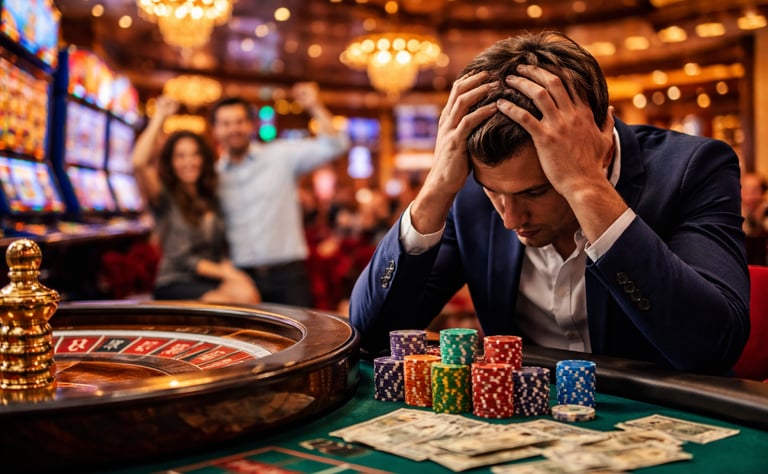
18. The Emotional Crash After Losing Winnings
Here’s the final stage:
Win big.
Give some back.
Chase.
Lose original deposit.
Deposit again to recover.
Spiral.
The pain of losing winnings feels worse than losing starting money.
Behavioral economists call this loss aversion.
Losses hurt about twice as much as gains feel good.
That pain drives irrational decisions.
The Hard Reality
Most people do not lose because they are unlucky.
They lose because:
Games are structured against them.
Psychology pushes continued play.
Emotions override math.
Temporary wins create overconfidence.
The house never stops playing.
The only guaranteed winning strategy in negative expectation gambling?
Not playing.
Final Thought
If someone wins and walks away permanently, they technically beat the system.
But the system is built around the fact that most people don’t walk away.
The true danger isn’t losing money.
It’s believing that the next bet will fix everything.
And that belief — more than luck — is what drains winnings in the end.
© 2026 All rights reserved.
Follow us
Quick Links