
Why This Tiny Asian City Is Called the “Las Vegas of Asia” — And It’s Not What You Think
Macau earns billions from casinos, luxury resorts, and nonstop nightlife — but that’s only half the story. Discover why Macau is called the Las Vegas of Asia and what makes it truly unique.
AWARENESS
2/27/20262 min read
The Small City That Quietly Overtook Las Vegas
When people hear “Las Vegas of Asia,” they often assume it’s just marketing.
It’s not.
The nickname exists because Macau has, for years, generated more casino revenue than Las Vegas.
That alone surprises most travelers.
But revenue numbers are only part of the story.
Macau isn’t simply copying Las Vegas. It built its own version of entertainment dominance — shaped by Chinese high-roller culture, Portuguese colonial heritage, and massive resort expansion.
Let’s break down why this tiny territory earned such a powerful title.
1. The Casino Revenue Factor
Las Vegas is globally famous.
Macau is globally dominant in gambling revenue.
The difference comes from player profile.
While Las Vegas thrives on tourism, conventions, shows, and nightlife, Macau historically attracted ultra-high-net-worth gamblers — especially from mainland China.
High-stakes baccarat tables generate enormous sums. A handful of VIP players can move millions in a single session.
That concentration of high-value gambling is what pushed Macau beyond Vegas financially.
2. The Cotai Strip Expansion
Much of Macau’s transformation happened after 1999, when it returned to Chinese administration and opened up casino licensing.
Developers built massive integrated resorts in the Cotai district — a reclaimed land area between Taipa and Coloane.
Today, properties like:
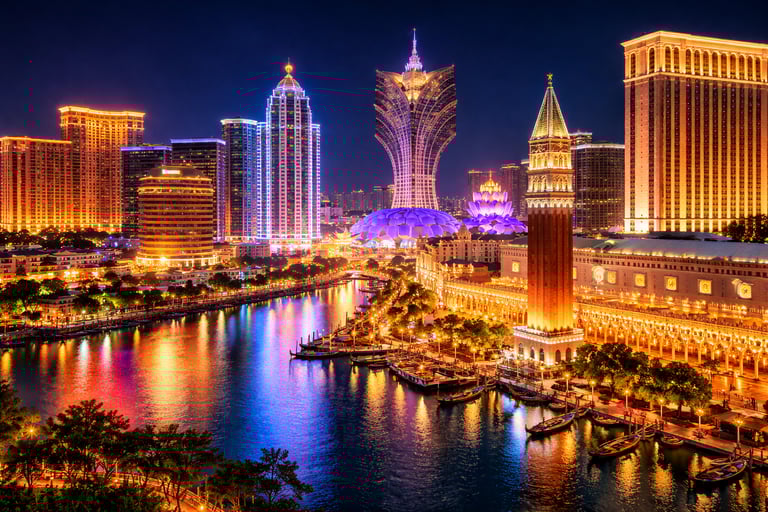
The Venetian Macao
Wynn Palace
MGM Cotai
offer enormous gaming floors, luxury suites, designer shopping arcades, Michelin-level dining, and full-scale entertainment complexes.
The scale is extravagant.
Everything feels engineered to impress.
3. A Gambling-Centric Economy
Las Vegas diversified decades ago.
Macau doubled down on gaming.
For many years, the majority of Macau’s GDP was directly linked to casinos. That level of economic reliance is rare for a city of its size.
Government regulation has recently shifted focus toward diversification, encouraging more non-gaming attractions. But gambling still defines the city’s global identity.
That’s the foundation of the nickname.
4. The Portuguese Influence Most People Don’t Expect
Here’s where Macau becomes different from Las Vegas.
Macau was under Portuguese administration for over four centuries.
Walk through the historic center and you’ll find:
Colonial-era churches
Mediterranean-style squares
Portuguese street names
Chinese temples nearby
The cultural blend is unique in Asia.
Unlike Las Vegas, which was built primarily as a desert entertainment hub, Macau carries layered historical identity alongside its casino dominance.
5. Compact Intensity
Las Vegas stretches wide.
Macau compresses everything into a small geographic footprint.
You can move between major resorts quickly. The density amplifies the energy. Neon lights, towering hotels, luxury malls — all tightly packed.
The experience feels concentrated and intense.
For visitors, that creates a sense of immersion.
6. High Rollers Defined Its Reputation
Macau became synonymous with VIP gaming rooms.
Private salons and exclusive baccarat tables once drove a massive portion of total revenue.
While regulatory adjustments reduced junket operations in recent years, the high-roller legacy cemented Macau’s image as Asia’s gambling capital.
That financial power is what earned global comparison to Las Vegas.
7. Beyond the Casinos
Although gambling dominates the narrative, Macau also offers:
Luxury shopping districts
High-end culinary experiences
Cultural heritage sites
Waterfront promenades
Observation decks with skyline views
It’s evolving.
There is now more emphasis on tourism diversity rather than pure gaming revenue.
Still, casinos remain the core attraction.
So Is Macau Truly the Las Vegas of Asia?
Yes — in terms of gambling scale, mega-resort infrastructure, and global casino branding.
But the comparison only goes so far.
Macau is:
More compact
More revenue-heavy on gaming
More culturally layered
Deeply influenced by both Chinese and Portuguese heritage
Las Vegas feels entertainment-first.
Macau feels gambling-first.
That distinction matters.
Final Perspective
The phrase “Las Vegas of Asia” simplifies a complex story.
Macau didn’t copy Vegas.
It created its own model — based on concentrated high-stakes gaming, rapid infrastructure expansion, and cross-cultural identity.
For travelers curious about global gambling hubs or unique urban transformations, Macau represents one of the most fascinating case studies in modern tourism economics.
If you’re exploring global destinations and want more detailed travel breakdowns, you can find additional destination guides and travel analysis at:
© 2026 All rights reserved.
Follow us
Quick Links